Cooled vs Uncooled Thermal Cameras: How to Choose for Long-Range Surveillance
How microbolometers and cryocooled detectors differ in sensitivity, range, start-up time, maintenance and cost, and the questions that point a surveillance project toward one or the other.

AIOEGY Editorial Team
Editorial Team
What this guide covers
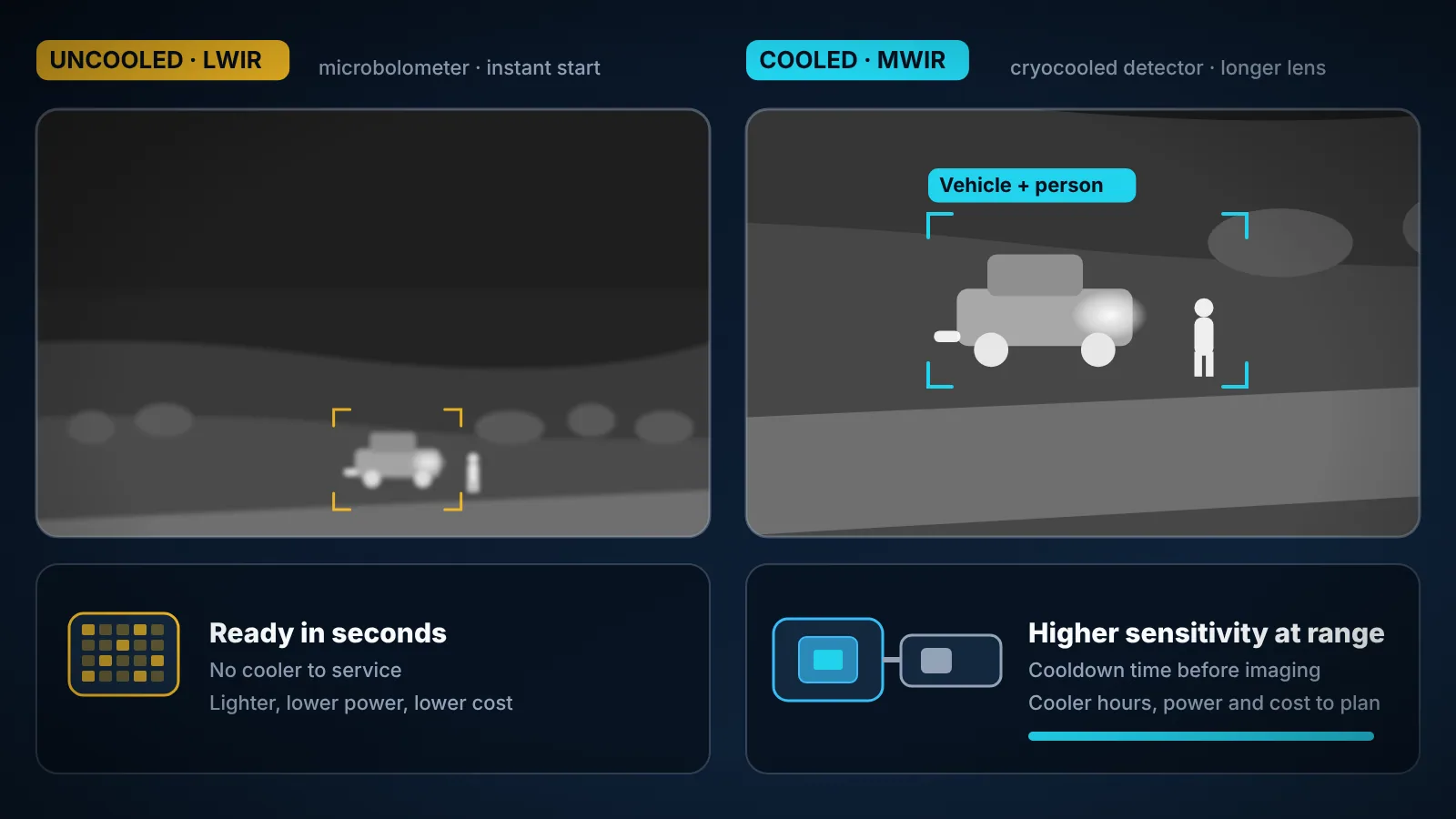
The short answer: uncooled thermal cameras are smaller, start almost instantly, use less power and need no cooler maintenance, which makes them the default for most short- and medium-range tasks. Cooled thermal cameras are more sensitive and pair well with long focal-length lenses, so they are usually chosen when an operator must recognize or identify targets at long range from a fixed post, mast or vehicle.
The right choice comes from the observation task, not from a headline range number. A camera that can detect a vehicle at a long distance may not let an operator tell what kind of vehicle it is. Atmosphere, target size, contrast, lens, mounting stability and the operator’s display matter as much as the detector.
This guide explains how each detector type works, what the MWIR and LWIR bands mean, how to read detection, recognition and identification ranges, and what cooled systems add to lifecycle planning. It extends AIO’s guide to electro-optical systems for defense and the article on long-range thermal surveillance for borders and critical infrastructure.
Key takeaways
- Uncooled: instant start, lower power, weight and cost, no cooler service.
- Cooled: higher sensitivity and long-lens performance, with cooldown time and cooler lifecycle to plan.
- Always ask which range criterion (detection, recognition or identification), target size and conditions sit behind a range figure.
- Band choice (MWIR or LWIR) interacts with humidity, heat and obscurants; field-test in your own environment.
- Write the operational task first, then shortlist detector, lens and platform together.
Cooled vs uncooled at a glance
Both types form an image from infrared energy emitted by the scene, but they sense it differently. The table summarizes the typical differences. Individual products vary, so use the table to frame questions for datasheets, not as a substitute for them.
| Factor | Uncooled | Cooled |
|---|---|---|
| Detector | Microbolometer (e.g. VOx or a-Si) | Photon detector (e.g. InSb, MCT or T2SL) at cryogenic temperature |
| Typical band | LWIR, about 8–14 µm | Often MWIR, about 3–5 µm (cooled LWIR also exists) |
| Start-up | Seconds | Cooldown before imaging, often minutes |
| Thermal sensitivity | Good | Higher: finer temperature differences visible |
| Lenses | Short to medium focal lengths common | Suits long focal-length and continuous-zoom lenses |
| Power, size, weight | Lower | Higher, because of the cooler |
| Maintenance | No cooler to service | Cooler has a rated service life to plan |
| Cost | Lower | Higher |
How an uncooled microbolometer works
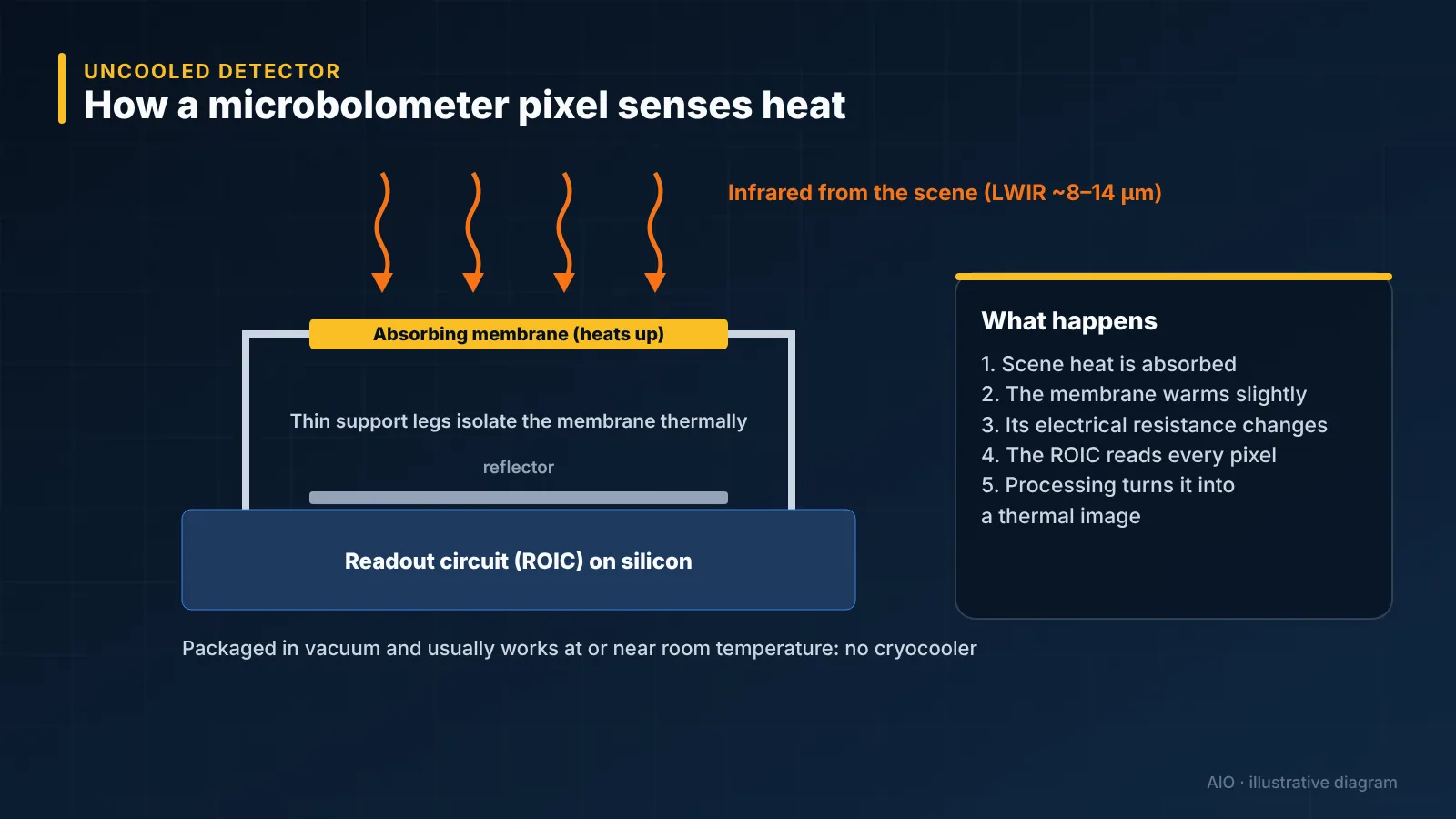
Each pixel of a microbolometer is a tiny membrane suspended above a readout circuit. Infrared energy from the scene warms the membrane slightly, which changes its electrical resistance. The readout circuit measures that change for every pixel, and image processing turns the measurements into a thermal picture.
Because the detector works at or near ambient temperature inside a vacuum package, it needs no cryocooler. That is why uncooled cores are compact, quiet, quick to start and well suited to handheld devices, weapon-mounted sights, vehicle cameras and many fixed surveillance posts.
Key considerations
- Ready to image within seconds of power-on.
- Lower power draw suits battery and mast-head installations.
- Sensitivity and resolution vary widely between cores; compare datasheets, not labels.
How a cooled detector works
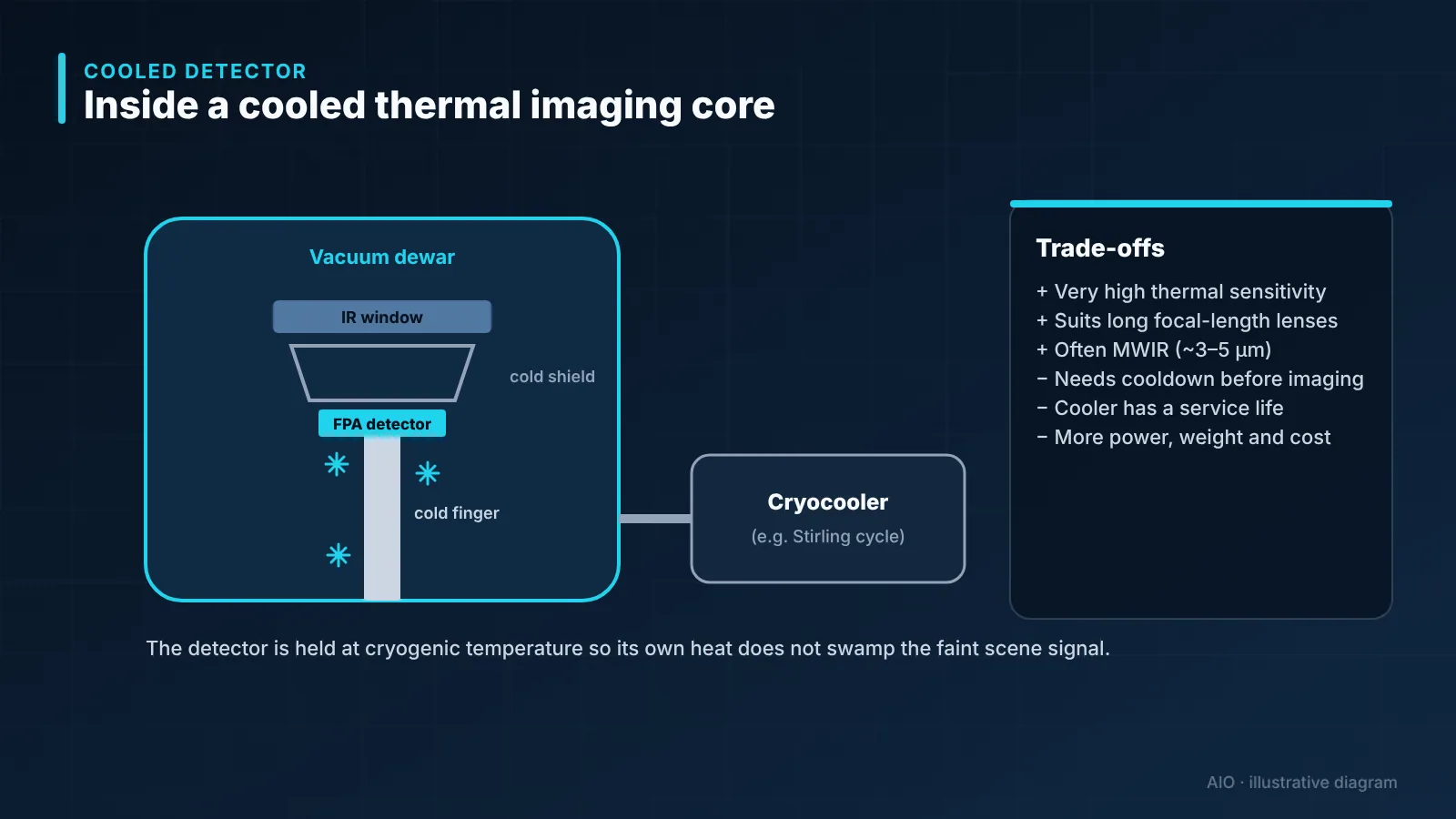
A cooled thermal core places a photon detector inside a vacuum dewar and uses a cryocooler, commonly a Stirling-cycle machine, to hold it at cryogenic temperature. Cooling suppresses the detector’s own thermal noise, so it can register very small temperature differences in the scene.
That sensitivity allows slower optics with long focal lengths, which narrows the field of view and puts more pixels on a distant target. The costs are a cooldown period before imaging, higher power consumption, more weight and a cooler with a finite rated life that must be serviced or replaced on schedule.
Key considerations
- Ask for the cooldown time at your expected ambient temperatures.
- Ask for the cooler’s rated service life in operating hours and the service procedure.
- Plan spares and support for the full operating period.
Range: detection, recognition and identification are different numbers
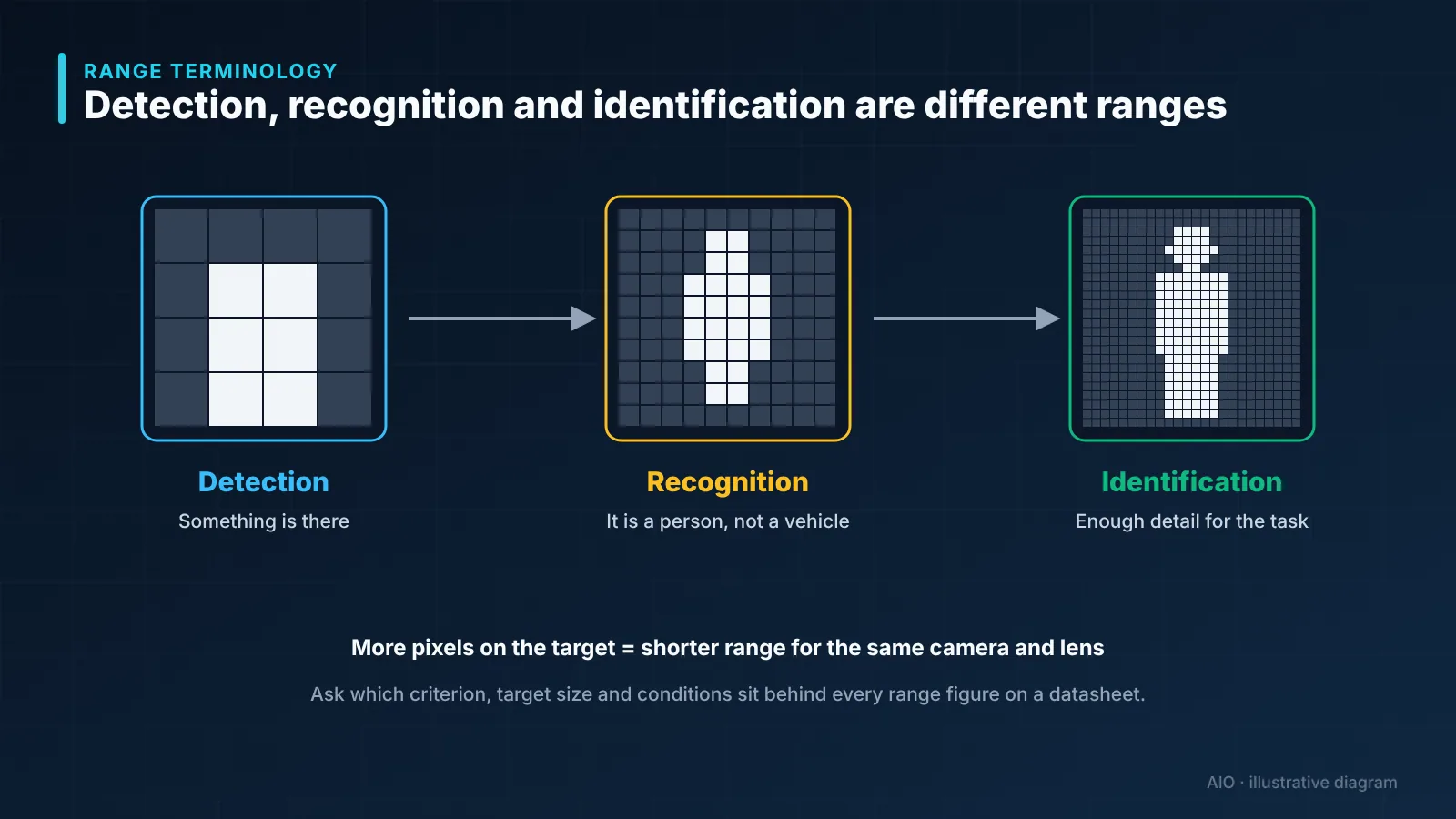
Thermal range is normally quoted against criteria descended from the Johnson criteria: detection (something is there), recognition (the class of object, such as person or vehicle) and identification (enough detail for the specific task). Each step needs more pixels across the target, so recognition and identification ranges are much shorter than detection range for the same camera and lens.
Range figures also assume a target size, temperature contrast and atmospheric condition. Two datasheets with the same headline distance may be using different assumptions. Ask suppliers to state the criterion, target dimensions and conditions, and to demonstrate performance against a representative target on your terrain.
Key considerations
- Specify the required task at each distance, not a single range.
- Compare products using the same criterion and target definition.
- Account for mounting height, terrain masking and line of sight.
MWIR, LWIR and the conditions on your site
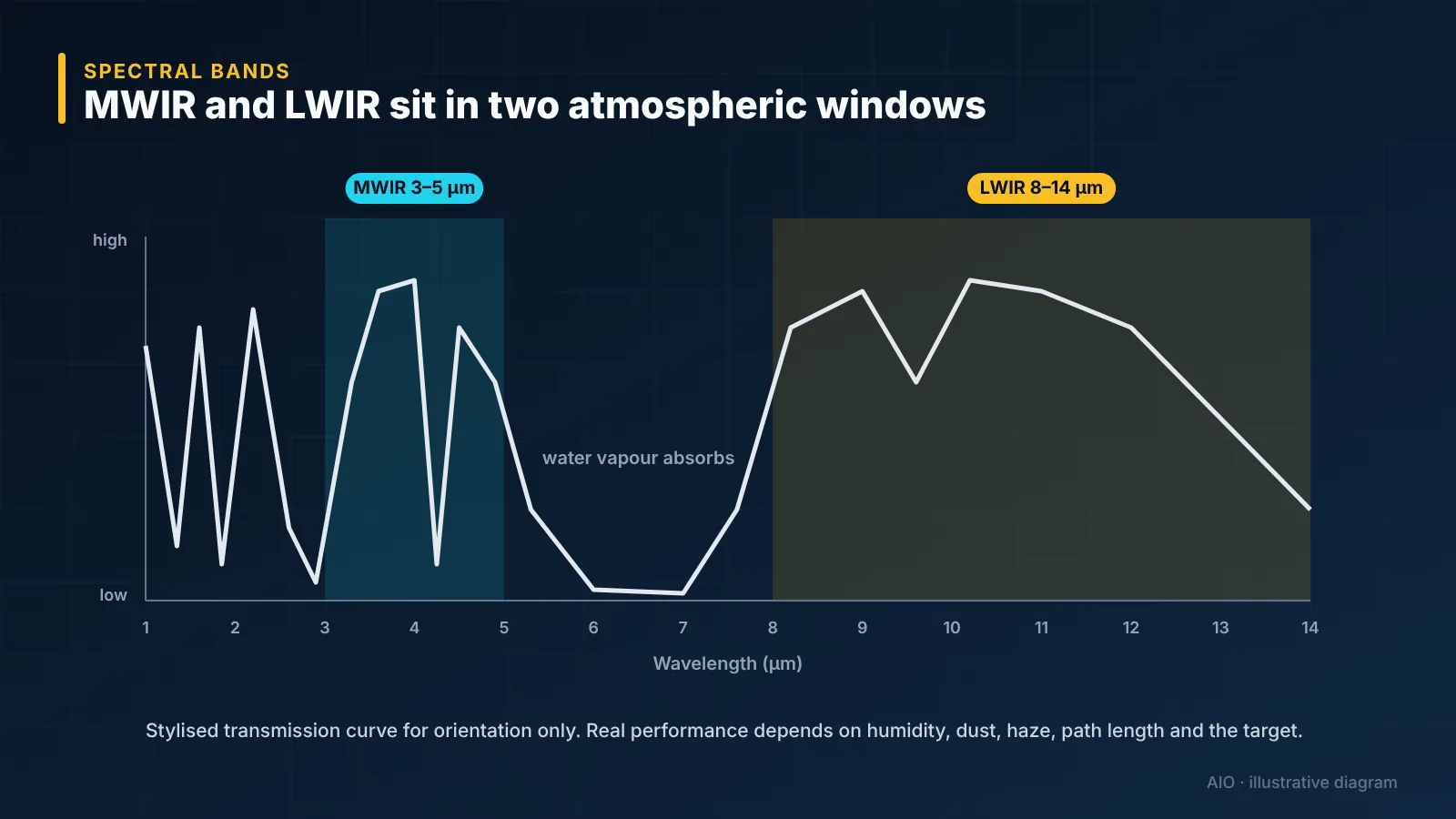
The atmosphere transmits infrared well in two main windows: mid-wave (about 3–5 µm) and long-wave (about 8–14 µm). Water vapor absorbs strongly between them. Cooled cameras often use MWIR; uncooled cameras use LWIR.
Which band performs better depends on humidity, air temperature, haze, dust, smoke and the targets you need to see. Coastal, desert and urban environments in the region can behave very differently across the day and the seasons. Treat general rules with caution and plan field tests at the times and seasons that matter to the mission.
Lifecycle, integration and procurement questions
The detector is only part of the system. Long-range observation also depends on stabilization, pan-tilt accuracy, lens quality, image processing, display and recording, and integration with radar, command-and-control or video management systems. A strong core on an unstable mast will disappoint.
For cooled systems, add cooler service intervals, spares holding and in-country support to the evaluation. For any thermal product, confirm environmental ratings, operating temperature range and applicable export or licensing requirements early in procurement.
Key considerations
- Stabilization and mount stiffness at the intended zoom level.
- Interfaces and video formats for the control room.
- Environmental testing evidence for heat, dust, shock and vibration.
- Training for operators to interpret thermal imagery.
Decision checklist and AIO’s thermal range
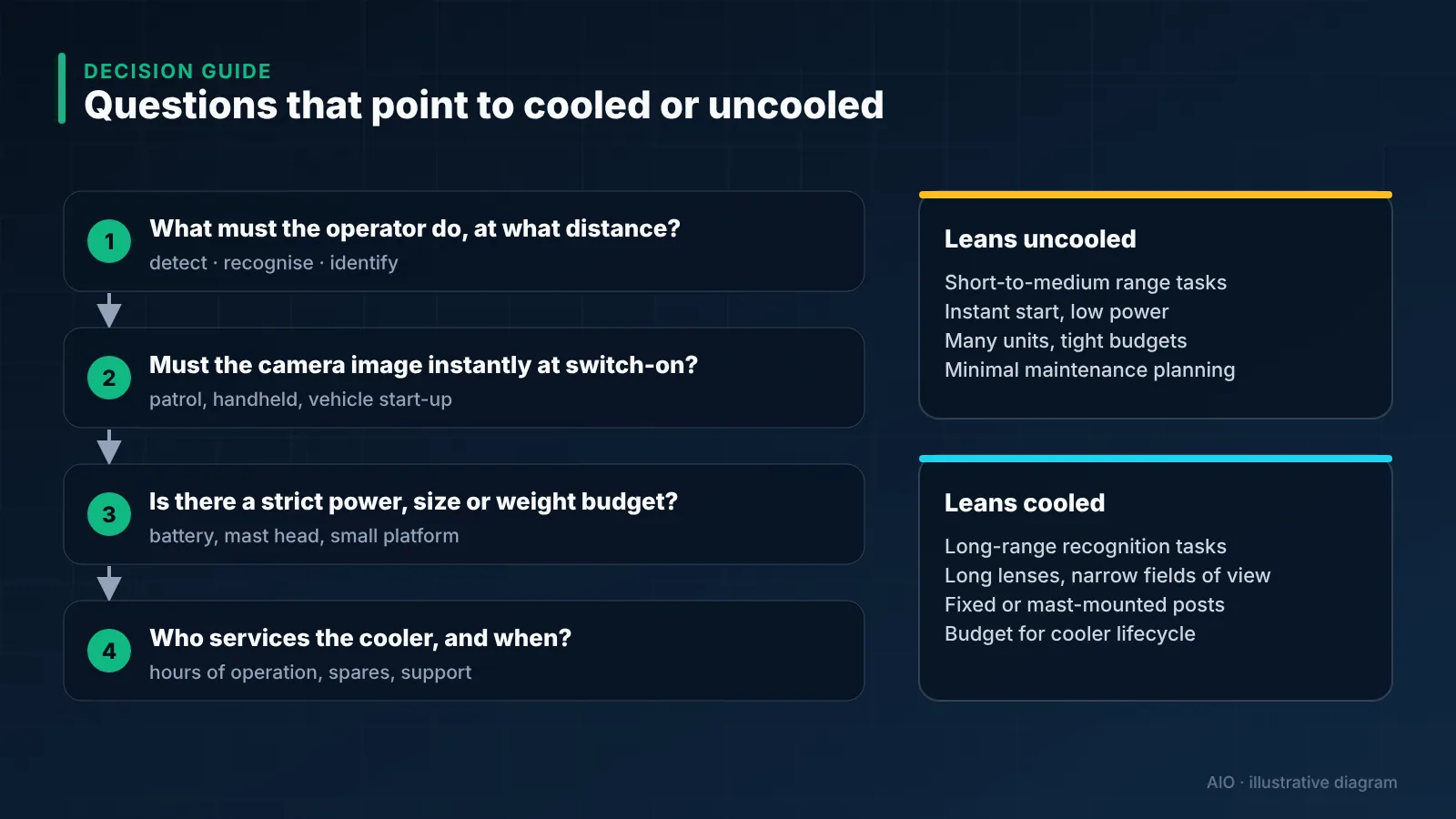
Work through the questions in order: the task and distance; whether the system must image instantly at switch-on; the power, size and weight budget; and who will maintain a cooler, and how often. Answers that stress instant start, low power and many units lean uncooled. Answers that stress long-range recognition from a fixed post with long lenses lean cooled.
AIO’s defense catalog includes thermal-device families and a dedicated long-range surveillance system. Product pages are the starting point for identifying candidate devices; detector type, lens options, range criteria and integration details should be confirmed in the model datasheet and in discussion with the defense division.
Relevant AIO products & next steps
Further reading
Electro-Optical Systems for Defense: Night Vision, Thermal Imaging & Fire Control
The main guide to electro-optical technology families.
Long-Range Thermal Surveillance for Borders and Critical Infrastructure
Coverage, terrain and integration for long-distance observation.
Armored Vehicle Night-Vision Systems (Arabic)
Driver vision and on-vehicle integration considerations.
Common questions
Is a cooled thermal camera always better?
No. It is more sensitive and suits long-range recognition with long lenses, but uncooled cameras start instantly, weigh less, use less power, cost less and need no cooler maintenance, which makes them the better fit for many tasks.
How long does a cooled thermal camera take to start?
It needs a cooldown period before it can image, commonly measured in minutes. The exact time depends on the core, cooler and ambient temperature, so ask for the figure in your conditions.
Can uncooled cameras be used for long-range surveillance?
Yes, within limits. With suitable lenses they can detect vehicles and people at useful distances. Where recognition or identification is needed at long range, cooled systems are more often specified.
What is the difference between MWIR and LWIR?
They are two infrared bands where the atmosphere transmits well: mid-wave around 3–5 µm and long-wave around 8–14 µm. Performance in each depends on site conditions such as humidity, heat and obscurants.
Need to discuss your requirements?
Contact AIO for current model information, datasheets and application-specific technical consultation.