PCB Manufacturing and Assembly in Egypt: How to Choose a Local Supplier
What to send for a quote, what a DFM review should catch, which inspection and quality standards to ask for, and how to move from prototype to volume with an Egyptian electronics manufacturer.

AIOEGY Editorial Team
Editorial Team
What this guide covers
Choosing a local PCB manufacturing and assembly partner in Egypt comes down to four things: whether they can build your board type reliably, whether their inspection and quality system matches your market, how they handle components and traceability, and how well they communicate engineering issues before they become production problems.
Sourcing locally can shorten logistics, simplify engineering visits and reduce exposure to international shipping delays, which matters for product companies, utilities, automotive suppliers and system integrators building in Egypt. It works best when the buyer sends a complete data package and the manufacturer reviews it properly.
This guide explains the vocabulary, the RFQ files that speed up quoting, what a design-for-manufacturing review should catch, the inspection methods and standards to ask about, and how to scale from prototypes to volume production.
Key takeaways
- Clarify whether you need bare-board fabrication, assembly (PCBA), testing, box build or all of them.
- Send a complete RFQ package: Gerber/ODB++, BOM with manufacturer part numbers, pick-and-place, drawings, test needs and volumes.
- Ask for a written DFM report before the first build.
- Agree the workmanship standard (for example IPC-A-610 class) and the inspection and test coverage.
- For automotive work, ask about IATF 16949; for every project, ask about traceability and change control.
Fabrication, assembly and box build are different jobs
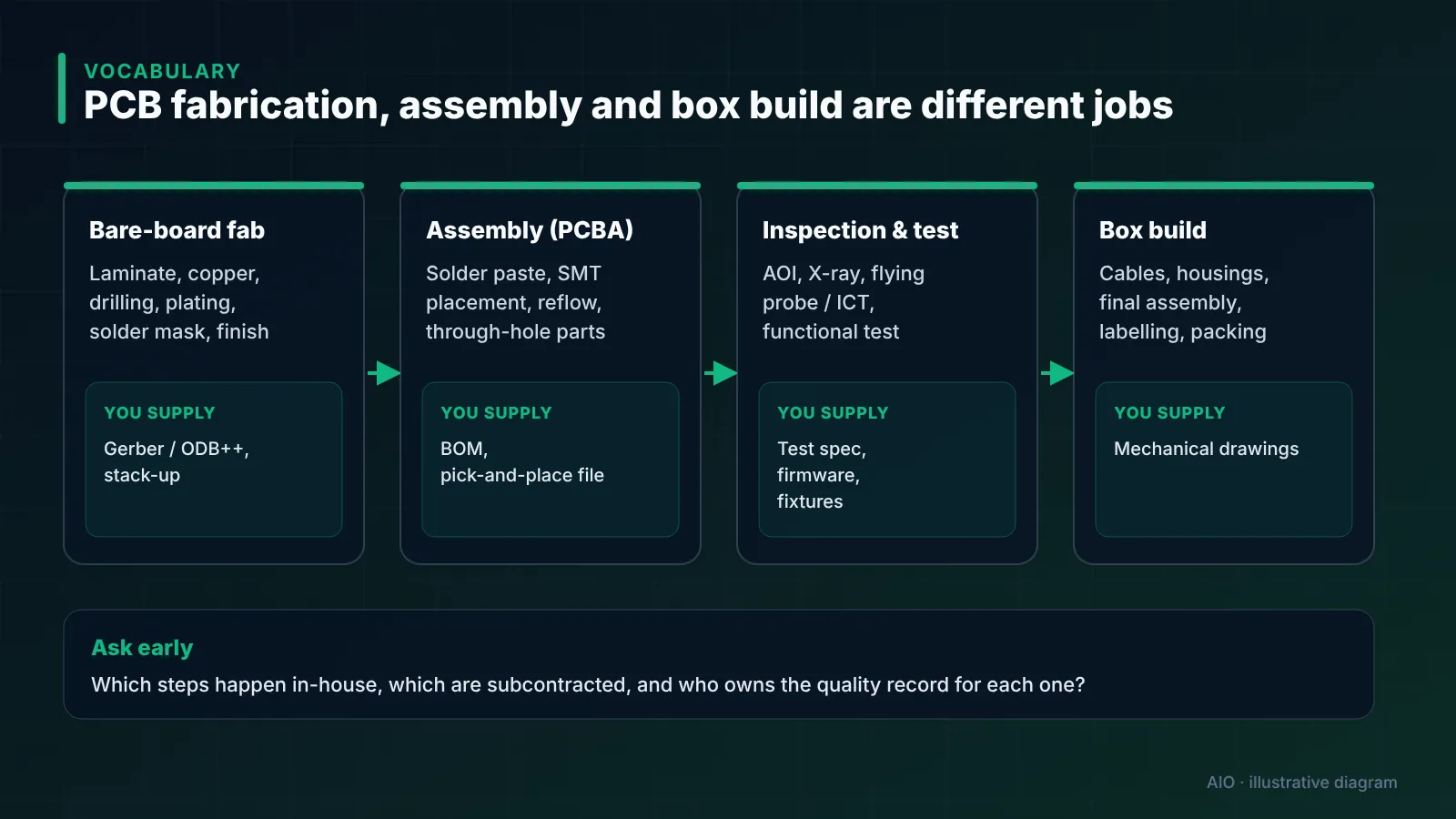
Bare-board fabrication produces the printed circuit board itself: laminate, copper layers, drilling, plating, solder mask and surface finish. Assembly (PCBA) places and solders components using solder paste, pick-and-place machines, reflow and, where needed, through-hole soldering. Box build integrates assembled boards with cables, housings and labels into a finished unit.
Some manufacturers do all three in-house; others assemble boards fabricated by partners. Neither is wrong, but you should know which steps are subcontracted, who controls quality at each step and who holds the records.
Key considerations
- Ask which steps are in-house and which are subcontracted.
- Ask who is responsible for board-level quality records.
- Confirm the scope of the quote: boards only, assembled boards or finished units.
What to send for a fast, accurate quote
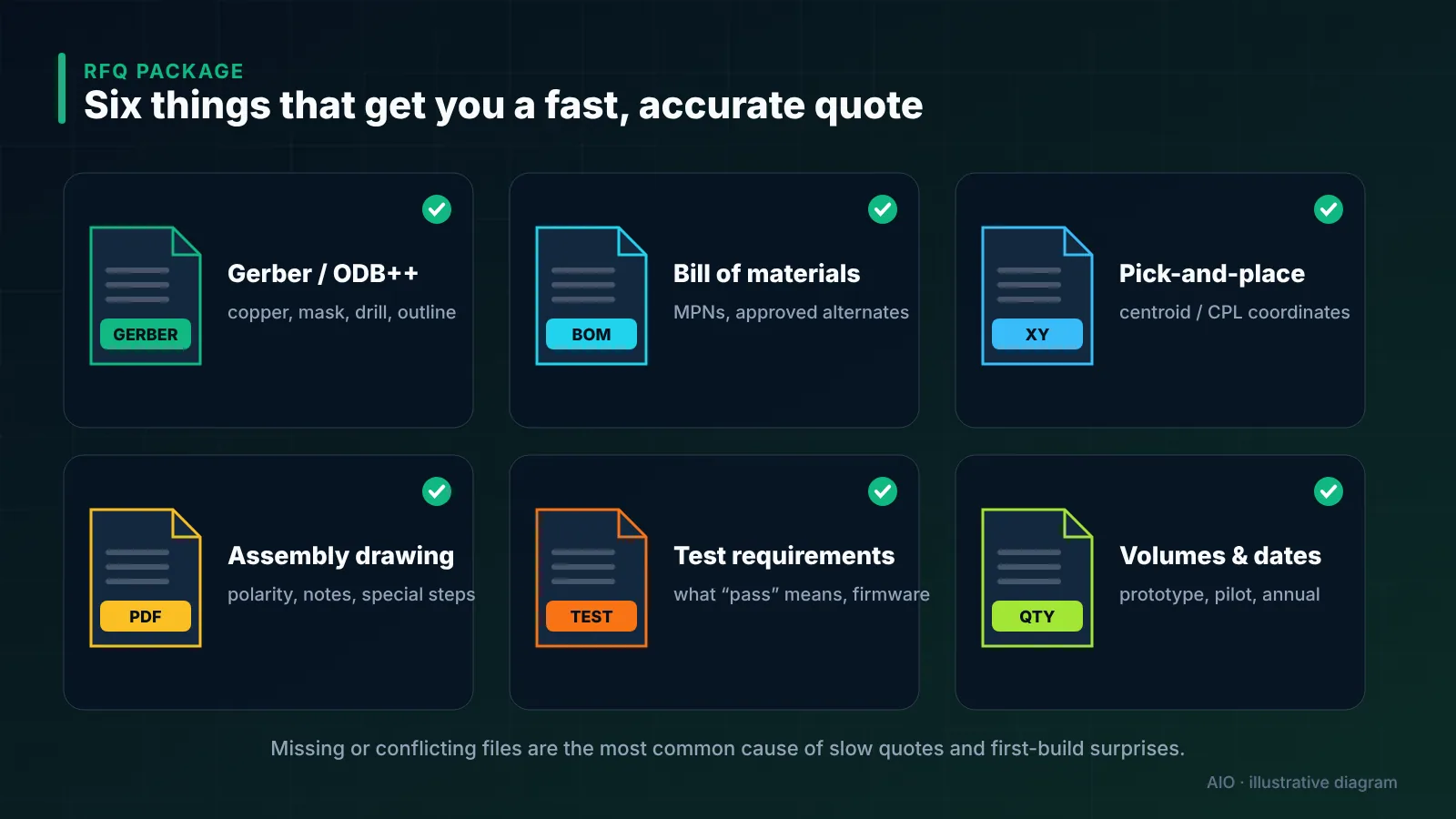
Most quoting delays come from missing or conflicting files. A complete package lets the manufacturer price materials, set up machines and flag risks in one pass. Include Gerber or ODB++ data with the stack-up and drill files; a bill of materials with manufacturer part numbers and approved alternates; a pick-and-place (centroid) file; an assembly drawing with polarity and special instructions; test requirements and firmware; and realistic volumes for prototypes, pilot runs and annual demand.
State whether you will supply any components yourself (consigned) or want the manufacturer to buy everything (turnkey). With long-lead or allocation-sensitive parts, agree who is responsible for sourcing risk and alternates before you place the order.
Key considerations
- Use one revision number across all files.
- Mark do-not-place parts and any special handling clearly.
- Include environmental requirements such as conformal coating or RoHS compliance.
Design for manufacturing (DFM): problems worth catching early
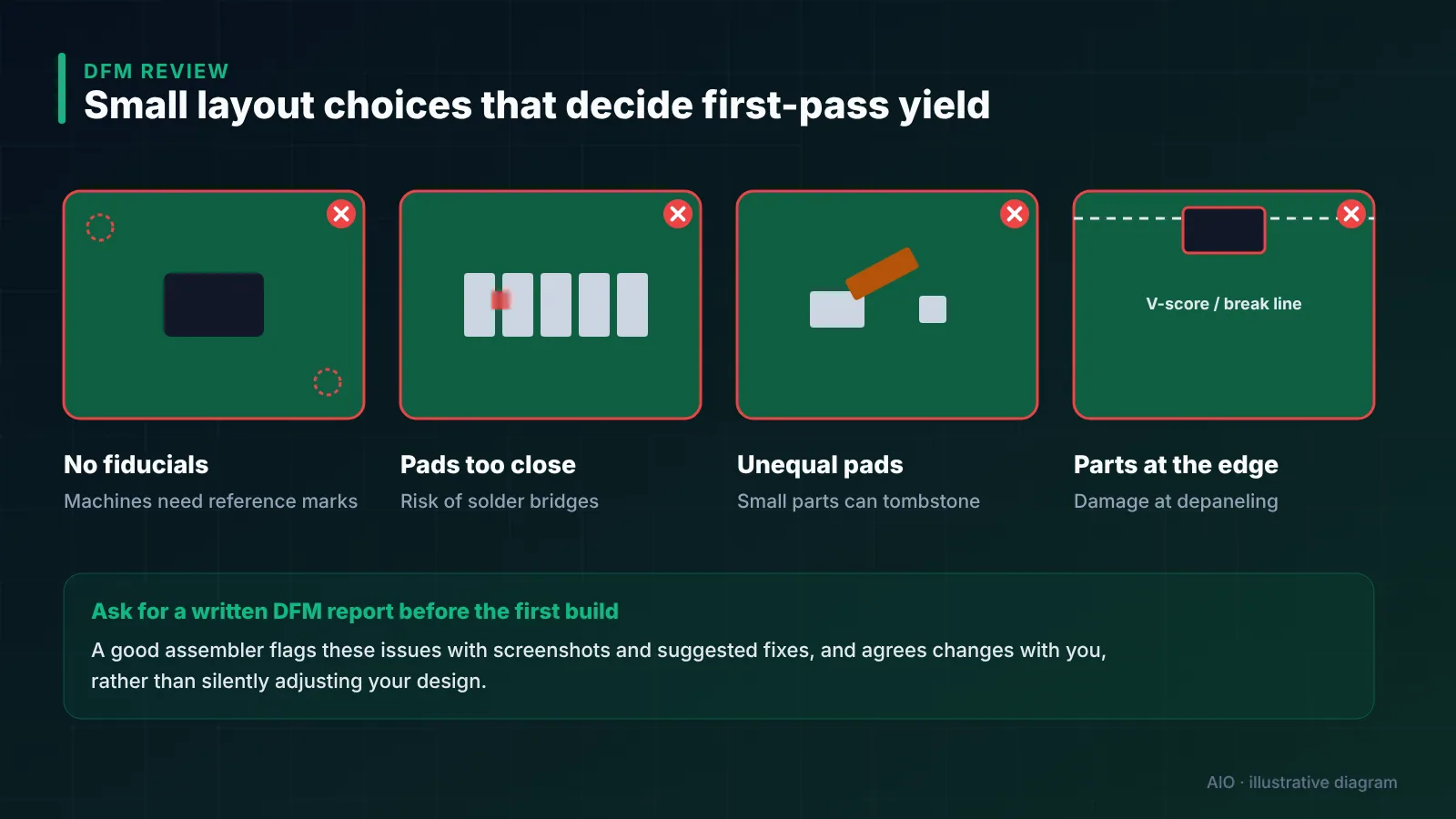
A DFM review checks whether the design can be built reliably at the intended volume. Typical findings include missing fiducial marks for machine alignment, pads too close together (bridging risk), unequal pads on small passives (tombstoning risk), components too close to the board edge or break-away lines, and thermal or via-in-pad issues under fine-pitch parts.
Ask for the DFM report in writing, with screenshots and recommended changes, and agree how changes are approved. A manufacturer that silently adjusts stencil apertures or layouts without telling you makes future builds unpredictable.
Inspection, testing and quality standards
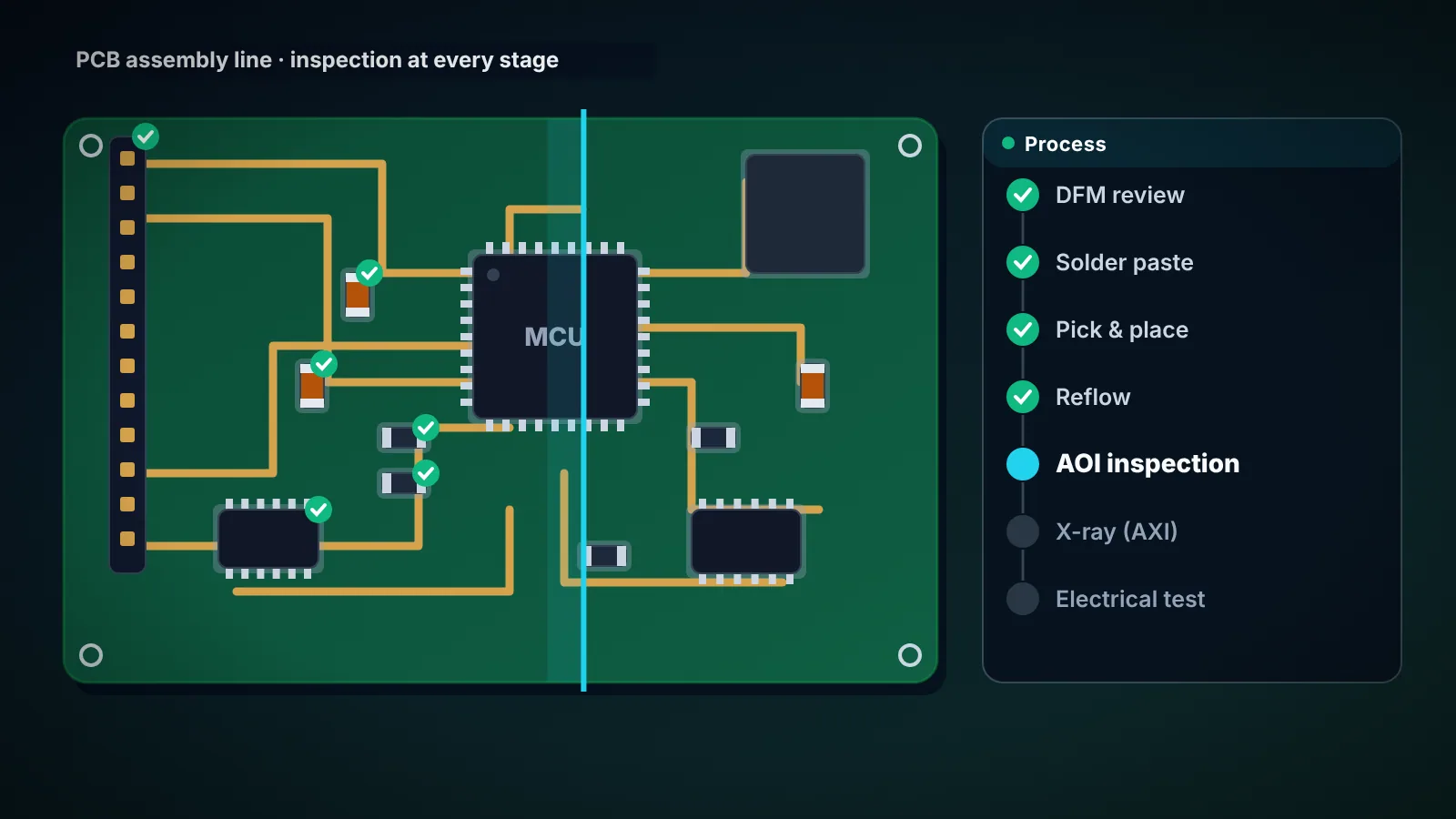
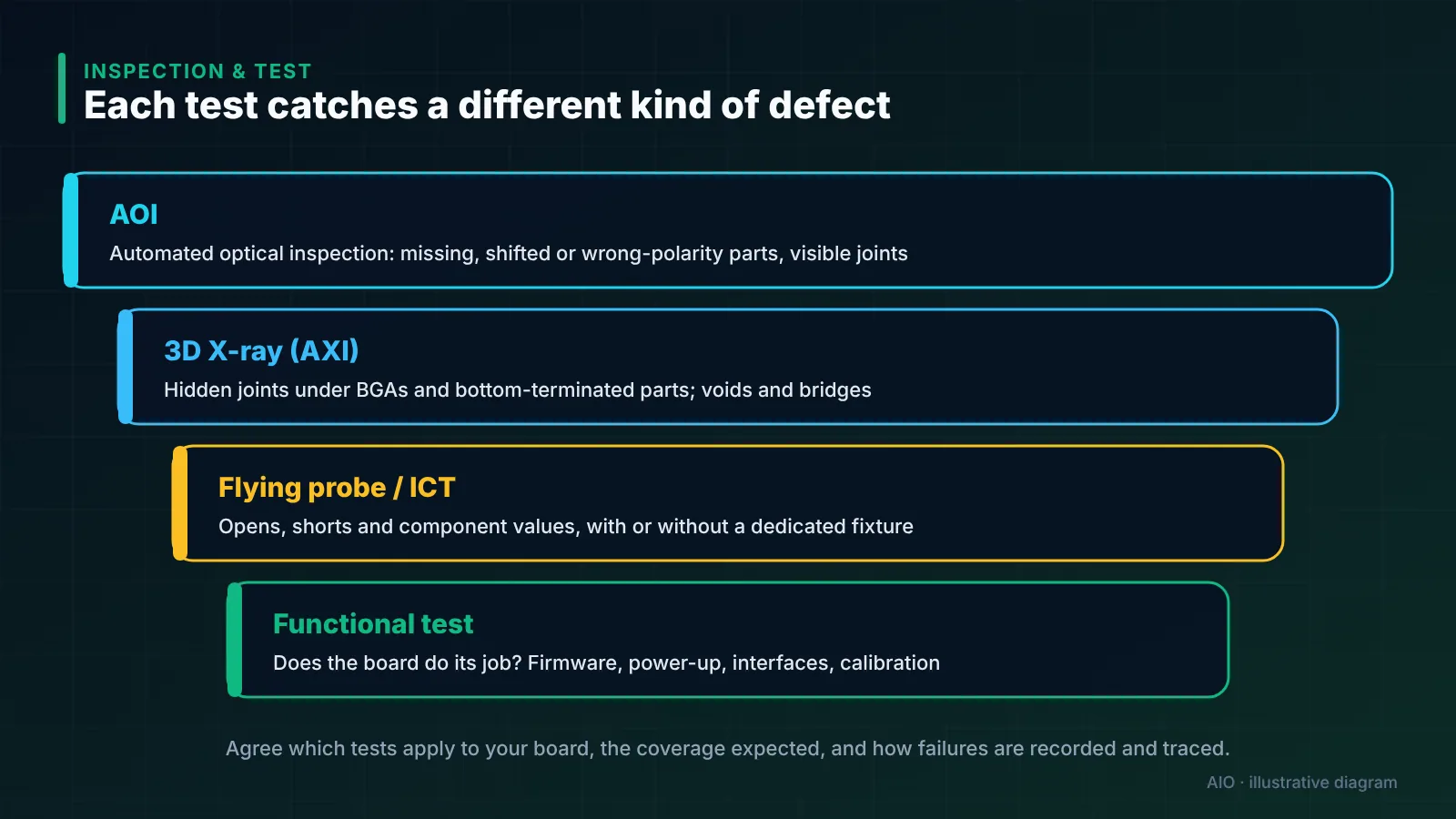
Each inspection method catches different defects. Automated optical inspection (AOI) checks visible joints and part placement. 3D X-ray (AXI) inspects hidden joints under BGAs and bottom-terminated components. Flying-probe or in-circuit testing (ICT) checks for opens, shorts and component values. Functional testing confirms that the board actually works with its firmware and interfaces.
Agree the workmanship standard, for example IPC-A-610 at Class 2 or Class 3 depending on the application, and the soldering process requirements such as IPC J-STD-001. For automotive supply chains, IATF 16949 certification of the quality management system is commonly required.
AIO’s Civil Quality page states that its PCB assembly is certified to IATF 16949 for high-precision automotive work, that it uses 3D X-ray (AXI) and flying-probe testing on PCB and prepaid-meter assemblies, and that it has held ISO 9001 certification since 1997. Ask for current certificates and the inspection plan proposed for your board.
| Method | What it finds | Notes |
|---|---|---|
| AOI | Missing, shifted or reversed parts; visible solder defects | Fast; limited to what a camera can see |
| 3D X-ray (AXI) | Voids, bridges and opens under BGAs and hidden joints | Essential for fine-pitch and area-array parts |
| Flying probe | Opens, shorts, component values | No dedicated fixture; suits prototypes and low volume |
| ICT | Opens, shorts, values, some functions | Needs a fixture; efficient at volume |
| Functional test | Whether the board performs its job | Needs a test specification and often a jig |
Components, traceability and change control
Component quality is board quality. Ask where components are sourced, how counterfeit risk is controlled, how moisture-sensitive devices are stored and baked, and how shortages are handled. For long-life products such as meters and industrial controllers, discuss obsolescence monitoring and last-time-buy decisions.
Traceability links each board to its components, process data and test results. It makes failure investigations faster and recalls narrower. Change control ensures that a component substitution or process change is approved before it reaches your product.
Key considerations
- Lot or serial traceability to component batches.
- Moisture-sensitive device handling procedures.
- Written approval for any substitution or process change.
From prototype to volume
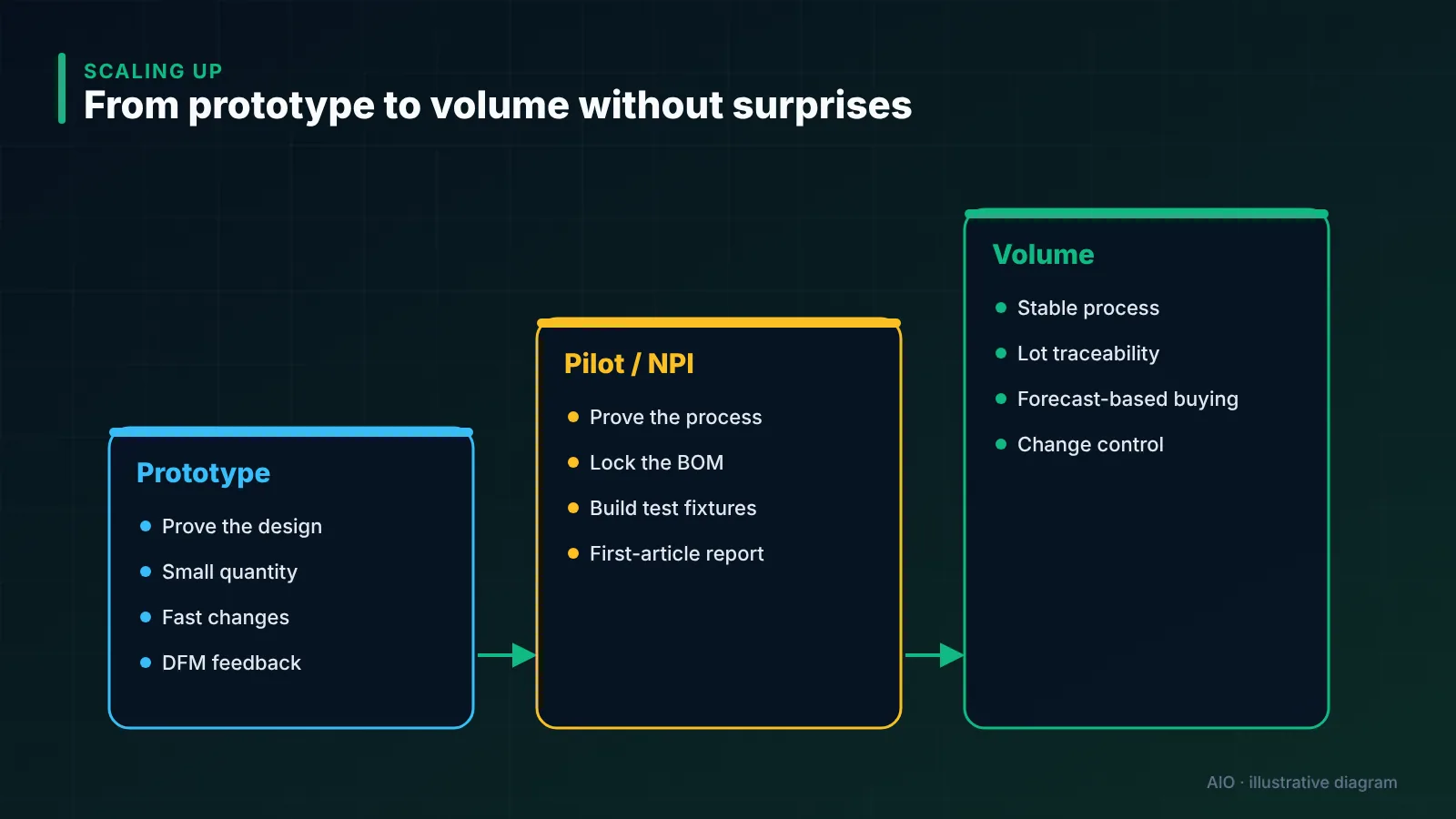
Prototypes prove the design and generate DFM feedback. A pilot or new-product-introduction run proves the process: the BOM is locked, test fixtures are built and a first-article inspection report confirms the build matches the design. Volume production then focuses on a stable process, forecast-based purchasing, traceability and change control.
Agree what each stage must deliver before moving to the next. Skipping the pilot stage to save time is a common source of field failures and expensive rework.
Supplier evaluation checklist and the AIO route
Visit the factory if you can. Look at incoming inspection, component storage, the SMT line, inspection stations and the test area, and ask to see an anonymized quality record. Score each candidate on the same criteria: capability for your board type, quality system and certifications, inspection coverage, engineering communication, sourcing and traceability, capacity and lead time.
AIO’s Civil division describes custom PCB design and manufacturing for automotive and industrial applications, specialized electronics for prepaid meters, and custom PCBs and IoT gateways for utility and smart-city systems. To evaluate fit for your product, share your RFQ package with the civil team and request a DFM review.
| Criterion | What good looks like |
|---|---|
| Capability | Has built similar technology, density and volumes |
| Quality system | Current certificates relevant to your market |
| Inspection coverage | AOI, X-ray and electrical test matched to your board |
| Engineering | Written DFM report and clear change approvals |
| Sourcing | Approved suppliers, MSD handling, alternates policy |
| Traceability | Board-to-component-lot records on request |
Relevant AIO products & next steps
Custom PCB Manufacturing
AIO’s electronics manufacturing capabilities for industrial and automotive boards.
PCBs brand page
Explore AIO’s PCB line and applications.
Civil Quality & Test Labs
Certifications, X-ray and flying-probe testing, and calibration services.
Contact AIO Civil
Send your RFQ package and discuss volumes and timelines.
Further reading
Common questions
What files do I need to get a PCB assembly quote?
Gerber or ODB++ data, a bill of materials with manufacturer part numbers, a pick-and-place file, an assembly drawing, test requirements and expected volumes. Missing files are the most common reason for slow or inaccurate quotes.
What is the difference between turnkey and consigned assembly?
In turnkey assembly the manufacturer sources all components. In consigned assembly you supply some or all components. Many projects use a mix, with responsibilities agreed in writing.
Which inspection methods should a PCB assembler use?
It depends on the board. AOI suits most assemblies; X-ray is needed for BGAs and hidden joints; flying probe or ICT checks electrical continuity; functional testing confirms the board works. Agree the coverage before production.
Why does IATF 16949 matter for PCB assembly?
It is the quality management standard widely required in the automotive supply chain. If your boards go into vehicles or automotive systems, your customer may require it from your assembly partner.
Need to discuss your requirements?
Contact AIO for current model information, datasheets and application-specific technical consultation.