LED Street Lighting in Egypt: A Specification Guide for Roads, New Cities and Compounds
How to specify LED street lights that suit the road, survive Egyptian heat and dust, and stay manageable for decades: lighting criteria, optics, luminaire build quality, layout, smart control and lifecycle cost.

AIOEGY Editorial Team
Editorial Team
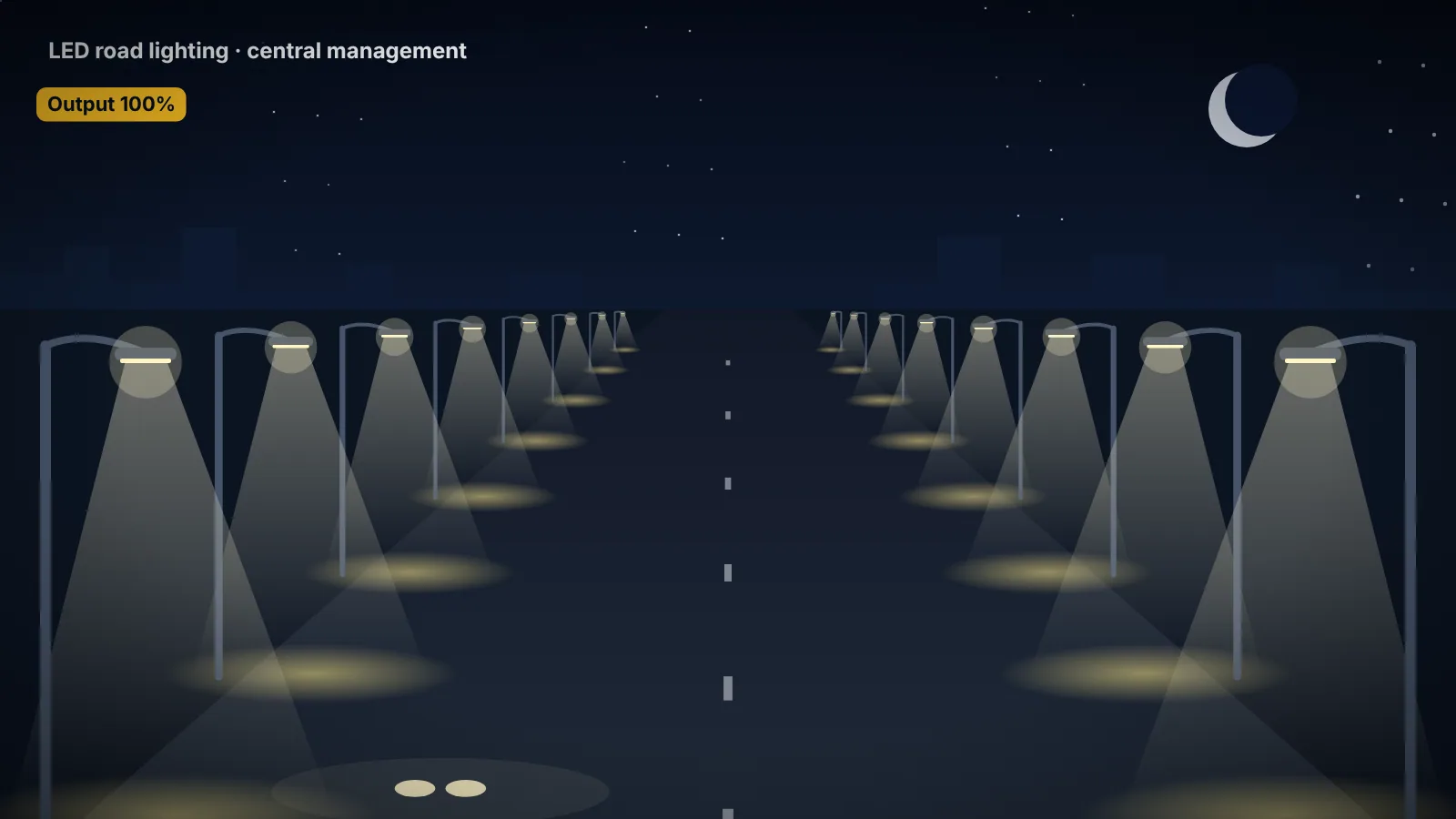
What this guide covers
A good LED street lighting specification starts with the road, not the wattage. The road class, traffic, pedestrians and surroundings determine the lighting levels and uniformity needed; the luminaire’s optic, efficacy and build quality determine how efficiently and reliably those levels are delivered. In Egypt, heat, dust and power-quality conditions make the build-quality questions especially important.
For municipalities, new-city developers, compound operators and contractors, the goal is a scheme that meets the design criteria on day one and keeps meeting them for many years with predictable maintenance. That means specifying photometry, thermal design, surge protection, ingress protection, controls and warranty together.
This guide walks through each decision in order and ends with a checklist you can adapt for tenders. It also explains where AIO’s OpticLit lighting and laboratory capabilities fit.
Key takeaways
- Define the road class and design criteria first; select luminaires to meet them in a lighting calculation.
- Ask for photometric files and independent test data, not only wattage and lumen claims.
- Specify thermal design, surge protection and IP/IK ratings for Egyptian outdoor conditions.
- Plan controls (dimming, schedules, fault alerts) at design stage, even if a CMS is added later.
- Compare lifecycle cost (energy, maintenance, failures) rather than purchase price alone.
Start with the road class and lighting criteria
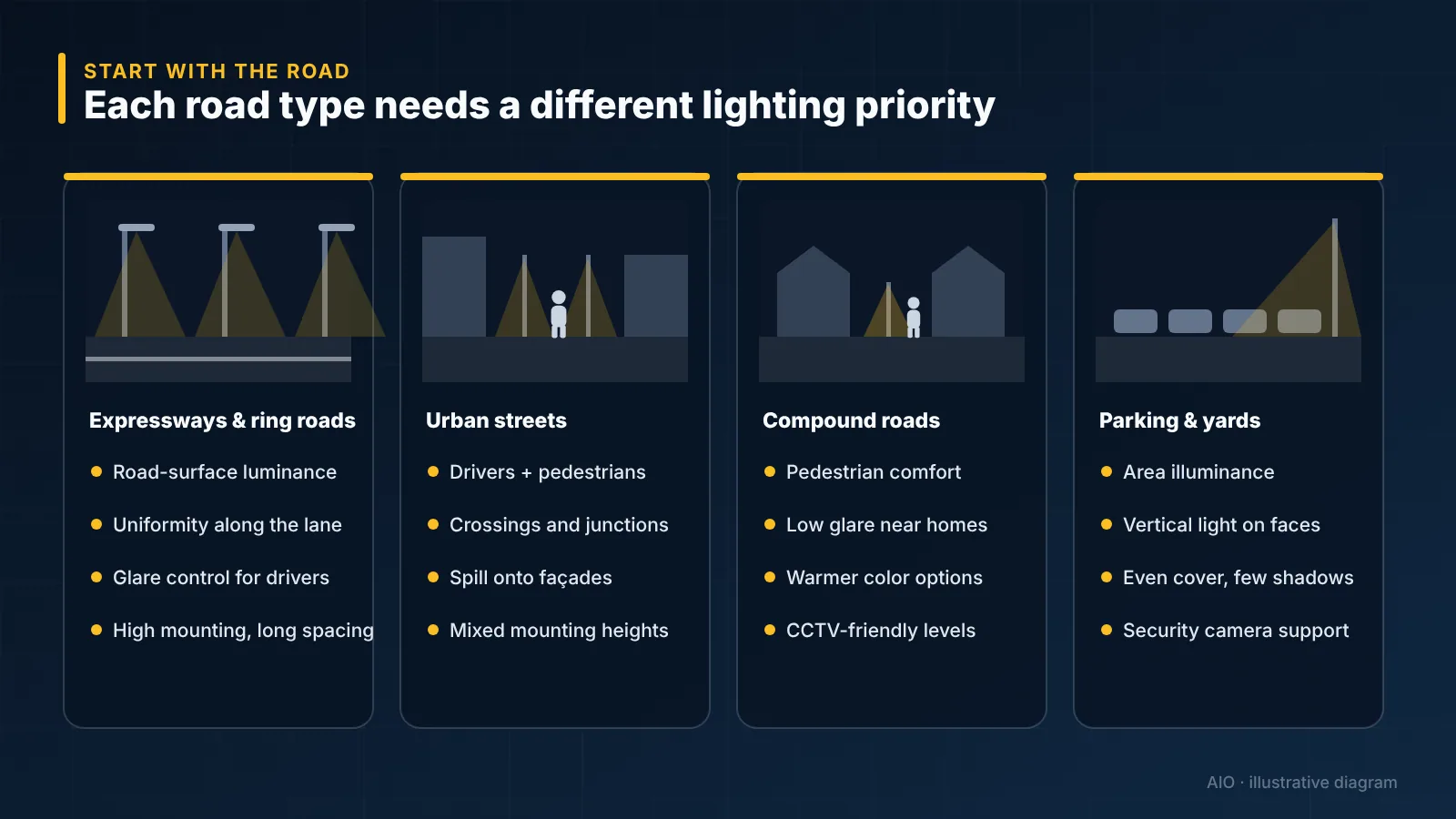
Expressways and ring roads are designed mainly around drivers: road-surface luminance, uniformity along the lane and glare control. Urban streets must also serve pedestrians at crossings and junctions. Compound and residential roads prioritize pedestrian comfort, low glare near homes and often warmer color temperatures. Parking areas and yards need even area illuminance and vertical light on faces and vehicles, which also helps security cameras.
Consultants commonly base criteria on the applicable Egyptian specifications and on international references such as CIE 115 and the EN 13201 series. Whatever the reference, agree the lighting class for each road segment in writing before comparing luminaires, so every bid is evaluated against the same target.
Key considerations
- Segment the project: main roads, local streets, junctions, crossings, parking.
- State the criteria (luminance or illuminance, uniformity, glare) for each segment.
- Note constraints: existing poles, trees, overhead lines, nearby homes.
Optics, efficacy and color: what to specify in the luminaire
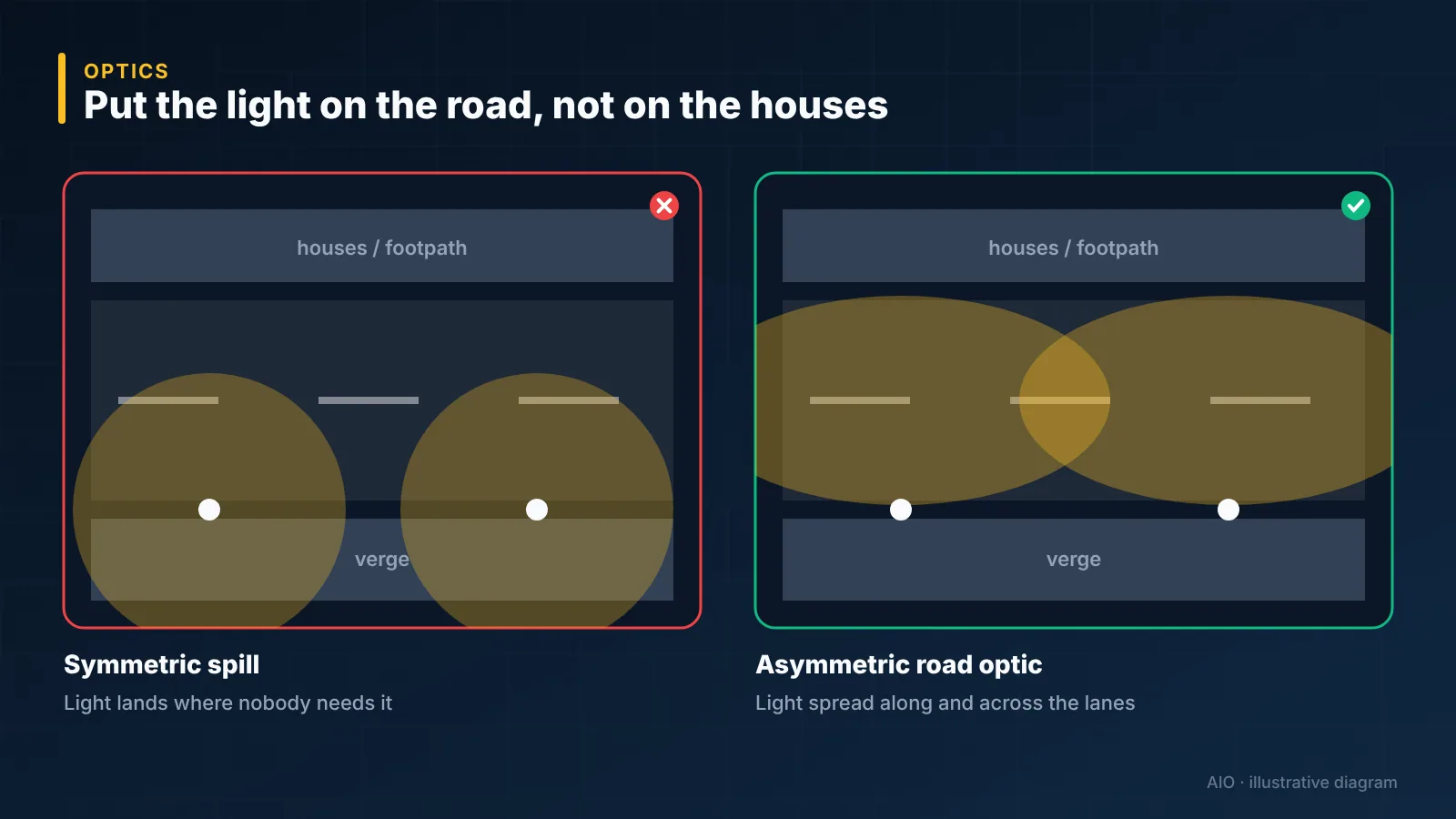
Street optics shape light asymmetrically so that it spreads along the road and across the lanes rather than falling equally in every direction. The right distribution lets you meet uniformity with fewer poles and less spill onto façades, bedrooms and the night sky. Ask for the distribution type and, more importantly, the photometric file (IES or LDT) so the designer can model it.
Luminous efficacy (lumens per watt) matters for energy, but only the light that lands where it is needed counts. Also specify correlated color temperature, color rendering, glare limits and the lumen maintenance basis (for example LM-80 data with a TM-21 projection for the LED package, plus luminaire-level LM-79 test reports).
Key considerations
- Photometric files from an accredited or recognized laboratory.
- Rated efficacy at the luminaire level, not only the LED chip.
- CCT and CRI appropriate to the road and neighborhood.
- Glare and upward-light limits for residential areas.
Built for Egyptian conditions: heat, dust and power quality
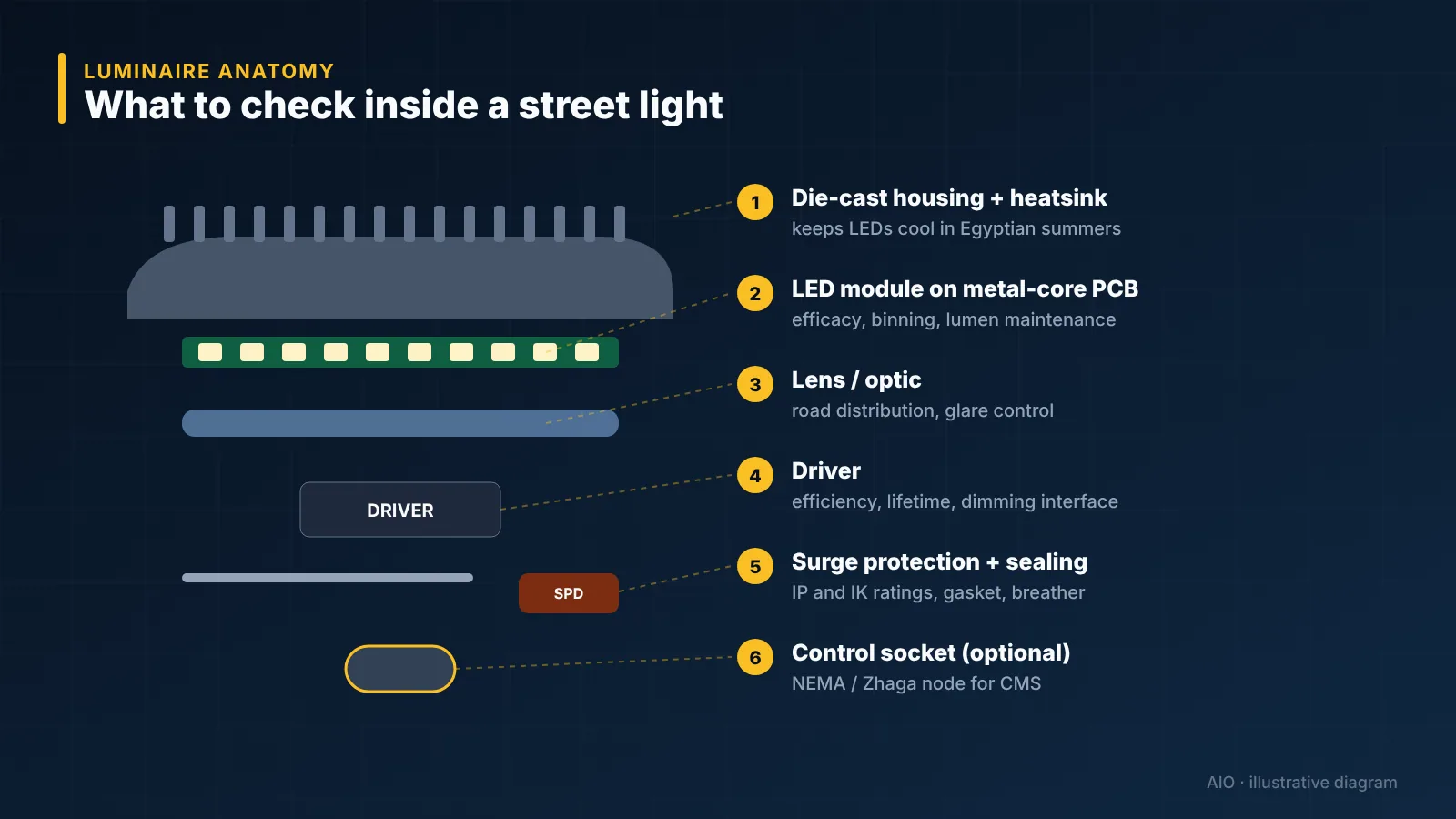
LED lifetime is closely tied to temperature. A luminaire with an undersized heatsink can run hot in summer, shortening driver and LED life. Ask for thermal test evidence at high ambient temperatures and for the driver’s rated lifetime at its case temperature.
Dust and washing call for robust sealing; specify an ingress protection rating (IP) and an impact rating (IK) suited to the mounting height and location. Lightning and switching surges are a frequent cause of failures, so specify surge protection levels for both common and differential modes, and confirm the driver’s own surge rating.
AIO’s Civil Quality page describes an industrial testing lab with goniophotometers for LED photometry and environmental simulation of extreme temperature, shock and vibration. It also lists UL certification and an ENEC license for its LED lighting. Ask for the test reports relevant to the exact luminaire you are evaluating.
Key considerations
- Housing material and heatsink design; maximum ambient rating.
- IP and IK ratings for the optic compartment and driver compartment.
- Surge protection device rating and replacement method.
- Corrosion protection for coastal projects.
Layout: mounting height, spacing and arrangement
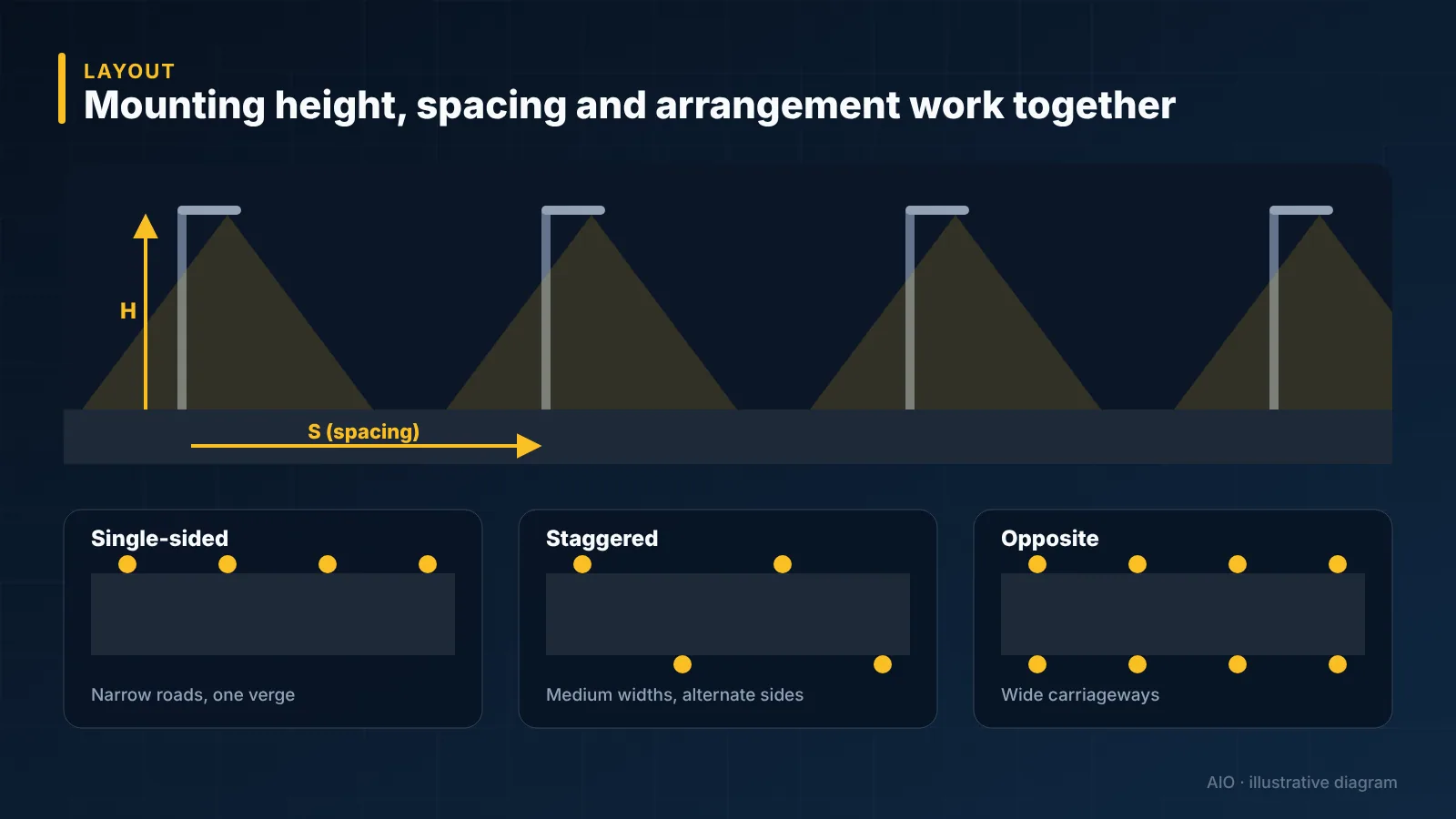
Mounting height, pole spacing, setback, arm length and tilt all interact with the optic. Single-sided layouts suit narrower roads; staggered layouts suit medium widths; opposite arrangements suit wide carriageways. A lighting calculation in software such as DIALux or a similar tool, using the bidder’s photometric file, is the only reliable way to confirm that a layout meets the criteria.
When retrofitting existing poles, the spacing is fixed, so the luminaire choice and its optic must fit the poles you have. Ask bidders to calculate on the real spacing and to state the maintenance factor they assumed.
Key considerations
- Use the same maintenance factor and road reflectance assumptions for every bid.
- Check junctions and crossings separately; they often need extra light.
- Coordinate with CCTV positions so cameras are not blinded by luminaires.
Smart control: dimming, schedules and a central management system
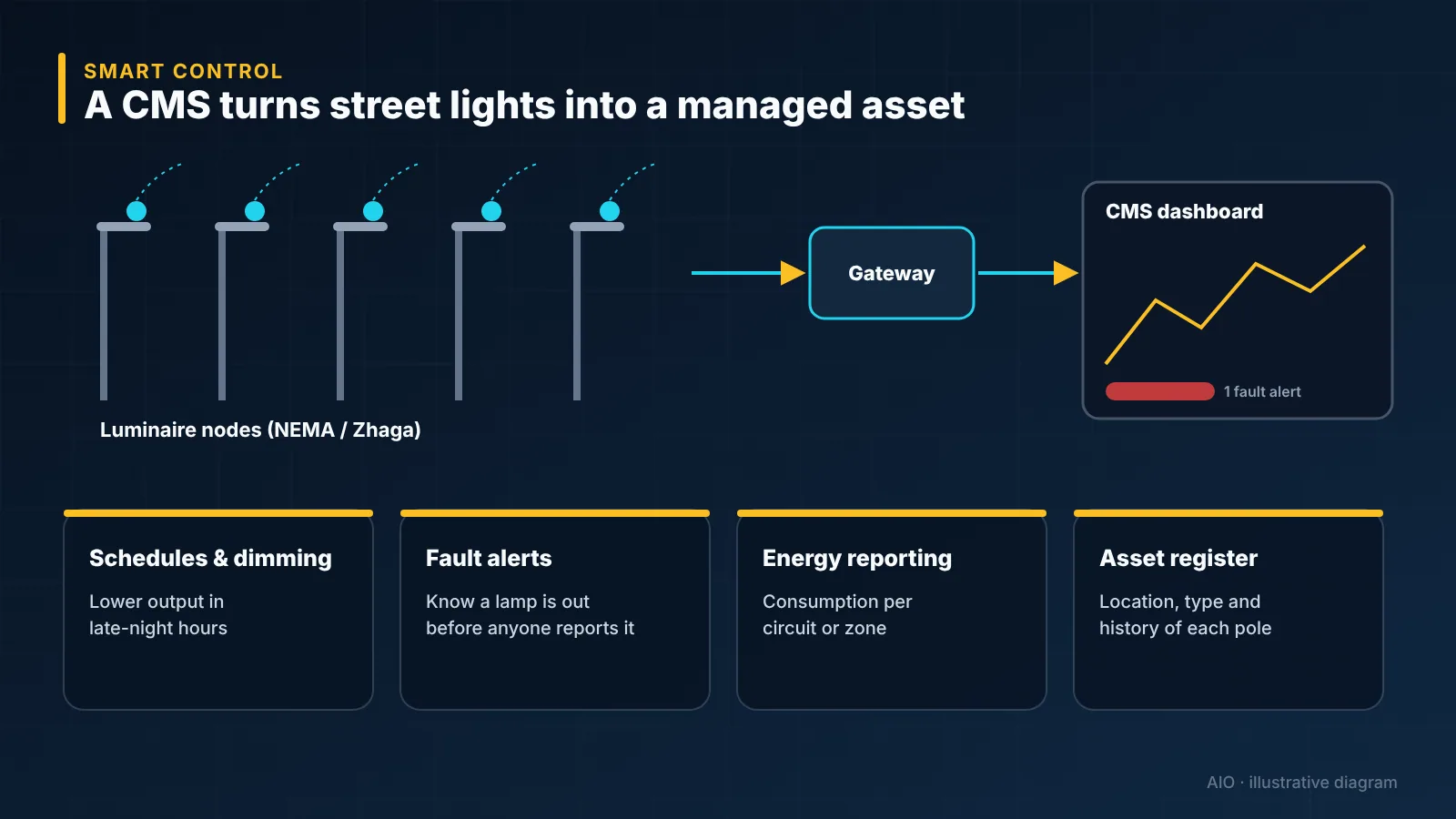
A central management system (CMS) connects luminaires through controllers, often fitted in standard NEMA or Zhaga sockets, to a gateway and a software dashboard. It lets operators set dimming schedules for late-night hours, receive fault alerts instead of waiting for complaints, measure energy per circuit and keep an asset register of every pole.
Even if a CMS is not funded in the first phase, specifying luminaires with a dimmable driver and a control socket keeps the option open. AIO’s smart-city pages describe adaptive CMS-based dimming to reduce municipal energy costs, and multifunction smart poles that combine lighting with services such as public Wi-Fi and information screens.
Key considerations
- Dimming interface (for example DALI-2 or 0–10 V) and socket standard.
- Communication method and coverage for the whole site.
- Data ownership, user access and integration with other city systems.
Solar street lighting: where it fits
Solar street lights avoid trenching and grid connection, which suits remote roads, desert sites, temporary works and locations where cabling is impractical. Their sizing depends on the panel, battery capacity, the lighting profile through the night and days of autonomy for dust and low sun. Battery temperature and replacement intervals deserve the same attention as the LED engine.
For long main roads with available grid power, grid-connected LED with CMS dimming is usually simpler to maintain. Compare both on lifecycle cost and on the lighting levels each can sustain all night, all year.
Lifecycle cost, warranty and the tender checklist
The cheapest luminaire can become the most expensive scheme if it needs more poles to meet uniformity, fails early in summer heat or lacks spare parts. Evaluate total cost: luminaires, poles and cabling, energy over the design life, maintenance visits, failure rates and the cost of replacing drivers or surge devices.
Warranty terms matter only when they are clear: what is covered, for how long, what failure threshold triggers a claim and how quickly replacements arrive. On its Civil services page, AIO describes its OpticLit LED systems for national highways and institutional interiors as backed by a 10-year guarantee, with the AIO-GL series spanning 45 W to 315 W, and cites lighting work on the Ring Road and the Suez–Ismailia corridor. Confirm warranty terms and model data for your specific project in writing.
| Item | Why it matters |
|---|---|
| Lighting calculation on the real layout | Proves the criteria are met with the proposed poles and spacing |
| Photometric file and LM-79 report | Lets the designer verify distribution and efficacy |
| LM-80 / TM-21 lumen maintenance data | Supports long-term light output claims |
| Thermal and environmental test evidence | Indicates performance in Egyptian summer conditions |
| IP, IK and surge protection ratings | Reduces failures from dust, impact and surges |
| Dimming interface and control socket | Keeps CMS and energy savings possible |
| Warranty terms and spare-parts plan | Defines who pays when something fails |
Relevant AIO products & next steps
LED Lighting Solutions
Review AIO LED lighting applications and request luminaire data.
Solar Panel Systems
Explore solar options for off-grid and remote lighting.
Civil Quality & Test Labs
Read about AIO photometric and environmental testing capabilities.
Contact AIO Civil
Share your road segments and criteria to discuss a specification.
Further reading
PCB Manufacturing and Assembly in Egypt
How to choose a local electronics manufacturing partner.
AI Video Analytics for CCTV in Egypt
Smart-city surveillance rules that work alongside good lighting.
AIO and KONE Strategic LOI for Sustainable Urban Development
AIO news on urban development collaboration in Egypt.
Common questions
How do I choose the wattage of an LED street light?
Do not start with wattage. Define the lighting criteria for the road, then use the luminaire’s photometric file in a lighting calculation on the actual pole layout. The lowest wattage that meets the criteria with the agreed maintenance factor is the right one.
What IP rating should an LED street light have in Egypt?
Specify a rating suited to outdoor dust and washing for both the optical and driver compartments, and confirm it with test evidence. Consider an impact (IK) rating as well for low-mounted luminaires.
Is dimming worth it on Egyptian roads?
On roads with lower late-night traffic, scheduled or adaptive dimming can reduce energy use while keeping appropriate light levels. It requires dimmable drivers and, ideally, a central management system with fault reporting.
When is solar street lighting a good choice?
Where grid connection is impractical or expensive, such as remote roads and desert sites. Size panels and batteries for the full night profile and for dusty, low-sun periods, and plan battery replacement.
Need to discuss your requirements?
Contact AIO for current model information, datasheets and application-specific technical consultation.