AI Video Analytics for CCTV in Egypt: What It Detects, What It Needs and Where It Pays Off
A practical guide to intrusion, line-crossing, loitering and safety rules: how analytics works, why camera placement decides accuracy, and how to run a pilot before scaling across your sites.

AIOEGY Editorial Team
Editorial Team
What this guide covers
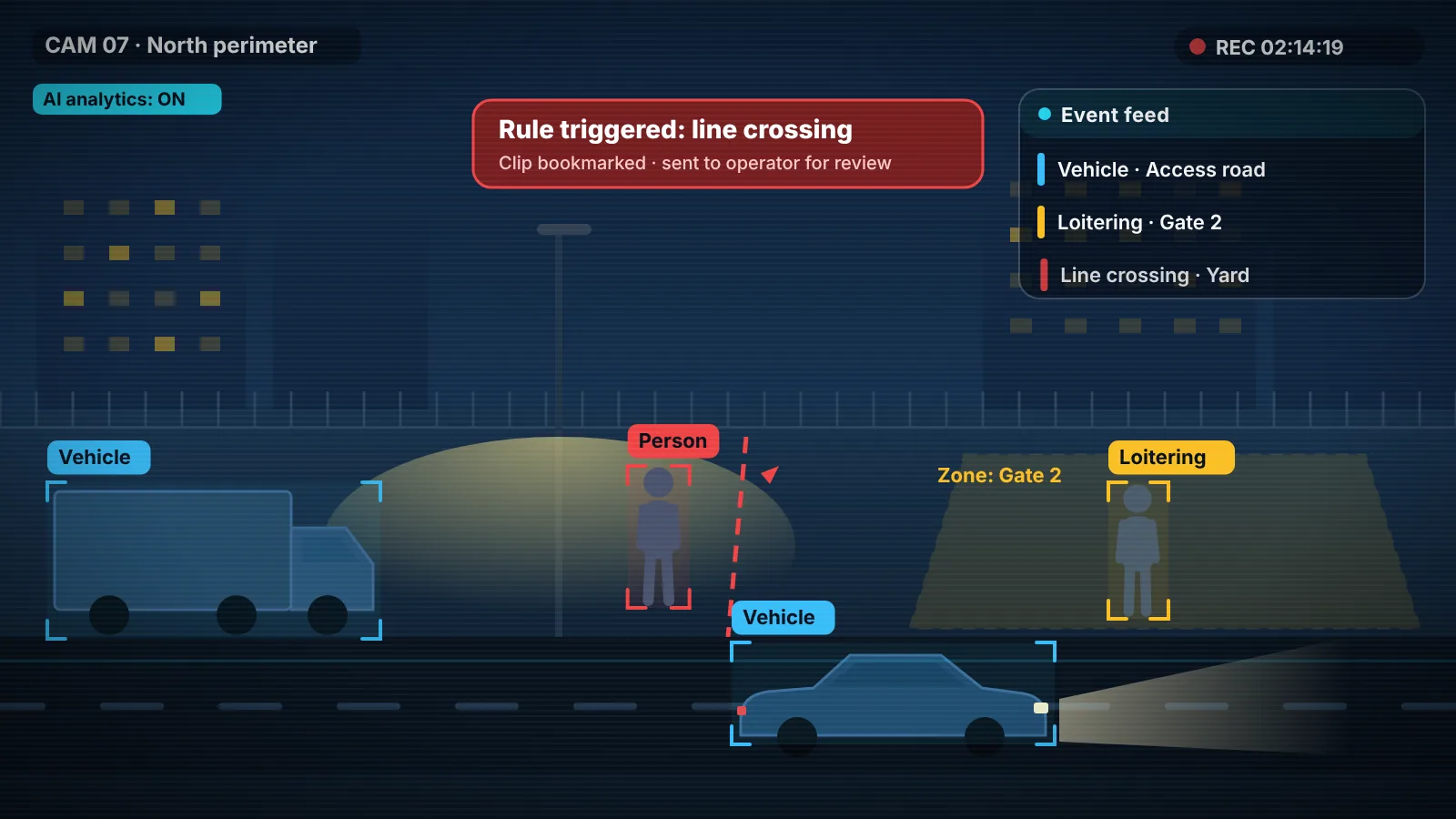
AI video analytics lets a CCTV system flag specific events, such as a person entering a restricted zone, a vehicle stopping at a gate after hours or someone lingering by a fence, instead of relying on an operator to watch every screen. In Egypt it is increasingly specified for factories, logistics yards, compounds, campuses and public infrastructure, where the number of cameras has grown faster than the number of people watching them.
The technology works best when it is treated as a filter, not a verdict. Analytics proposes an event; a trained operator confirms it and decides what to do. Results depend less on the algorithm’s marketing name than on three practical things: the camera’s position and image quality, how clearly each rule is defined, and how the site handles false alarms.
This guide explains the common analytics functions, the difference between processing in the camera and on a server, the placement mistakes that cause most false alarms, privacy obligations, and a pilot method you can use before buying for every site. It builds on AIO’s broader guide to CCTV and video surveillance systems in Egypt.
Key takeaways
- Write each rule as a sentence first: where, when, what object, and who responds.
- Aim analytics cameras for the rule they serve; a general overview camera is rarely ideal for detection.
- Choose edge or server processing based on bandwidth, existing cameras and how you want to update analytics.
- Measure true alerts, false alerts and missed events during a pilot before scaling.
- Handle video and event data under Egypt’s Personal Data Protection Law (Law No. 151 of 2020) with qualified advice.
What AI video analytics actually does (and does not do)
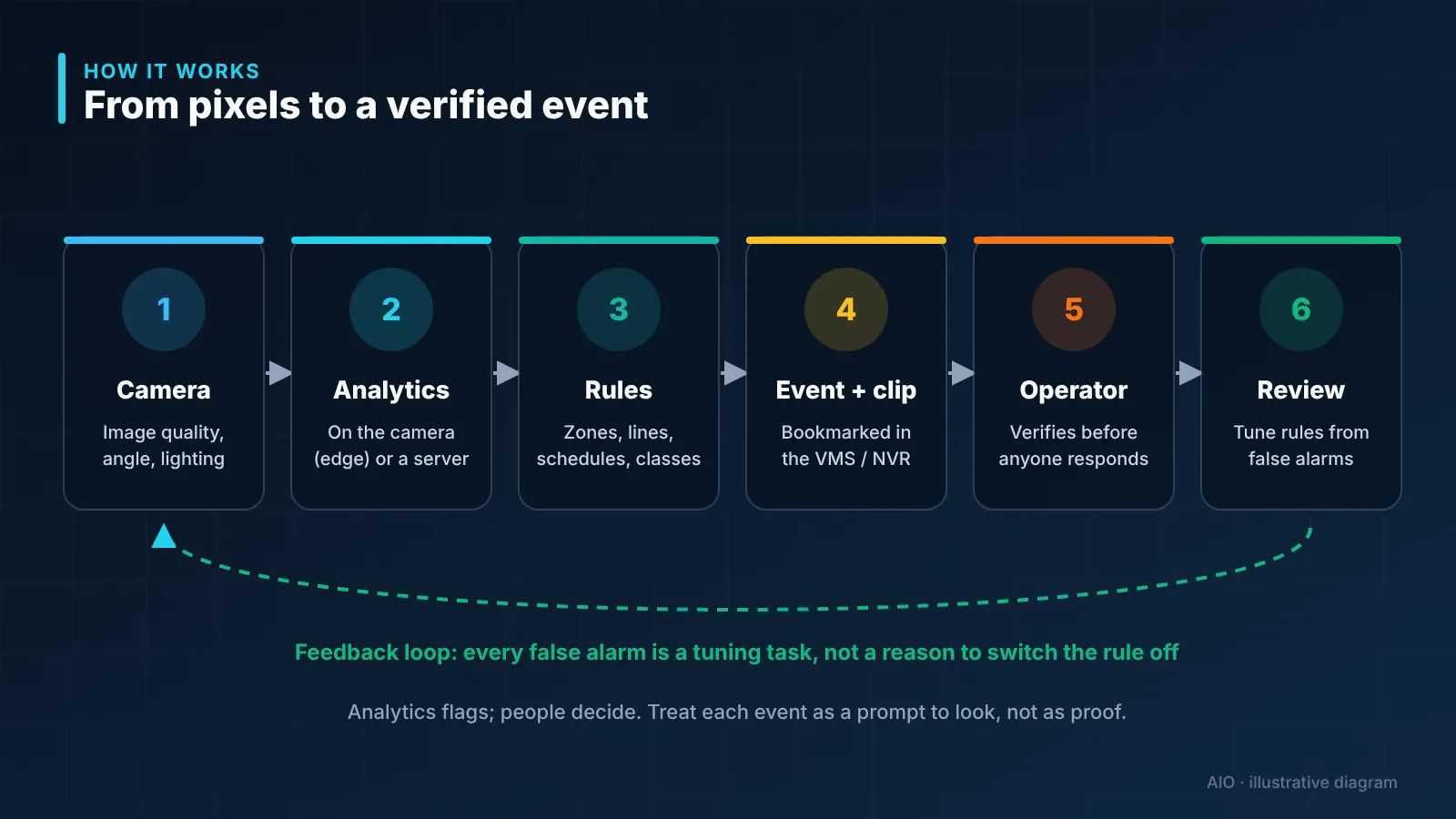
Video analytics software examines frames from a camera, detects objects such as people and vehicles, follows them across the scene and compares what it sees with rules you configure. When a rule is met (an object crosses a line in a set direction, or stays in an area longer than a set time), the system creates an event. A good integration bookmarks the related video clip in the video management system (VMS) or recorder so the operator can review it within seconds.
What analytics does not do is understand intent. It cannot tell a contractor from an intruder unless your procedures and access records provide that context. That is why the operator, the response procedure and the tuning loop are part of the system, not optional extras.
Key considerations
- Analytics reduces the number of screens an operator must watch continuously.
- Each event should carry the camera, time, rule name and a linked clip.
- False alarms are tuning data: record their cause and adjust the rule.
Common analytics rules and where they fit
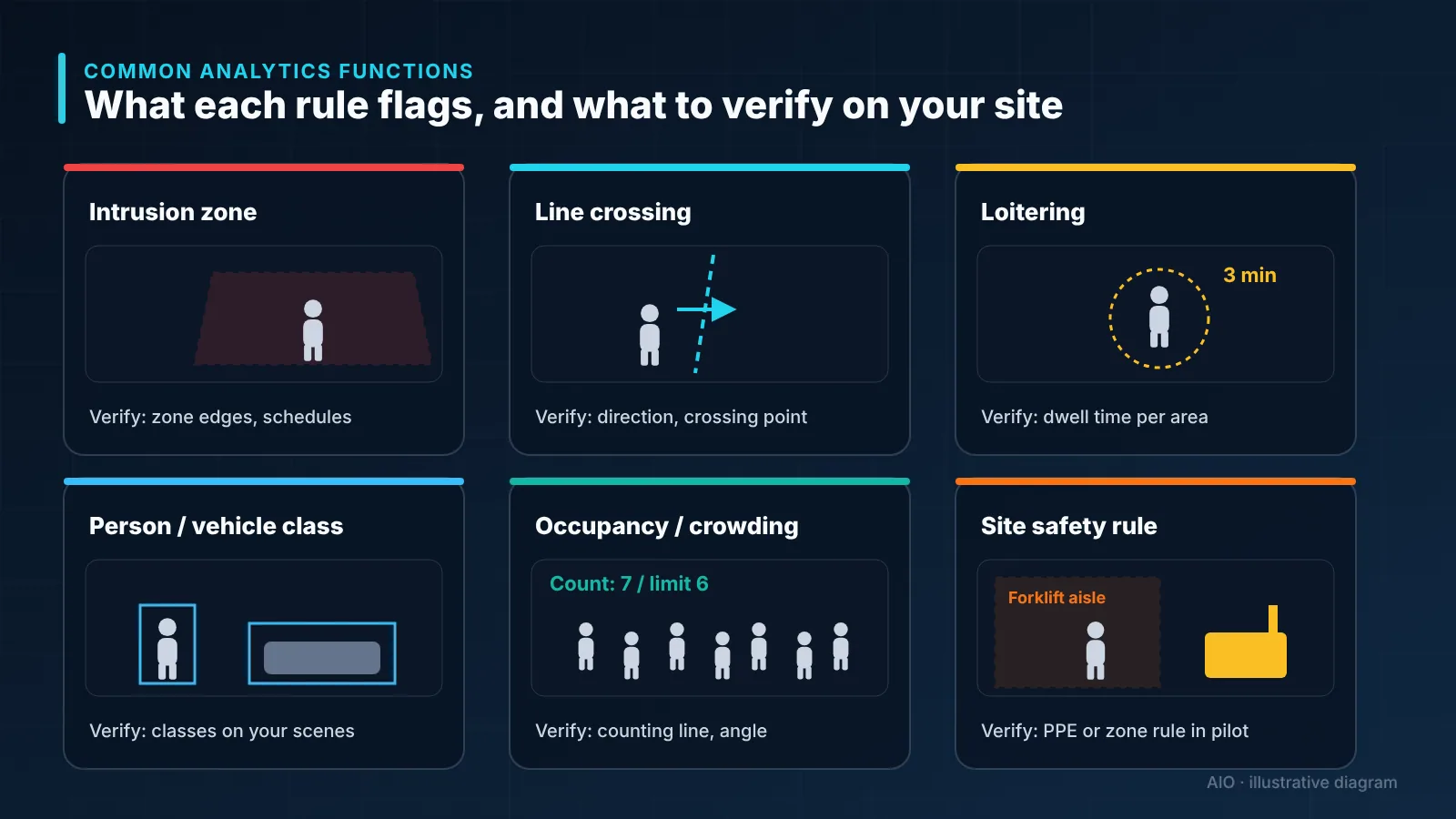
Most projects in Egypt start with a small set of rules that map directly to security or safety procedures. The table below summarizes the usual options. Availability depends on the specific camera, analytics licence and VMS, so treat it as a checklist for your datasheet review rather than a list of guaranteed features.
The query people search most, “AI CCTV safety monitoring”, usually refers to rules such as restricted-area entry around machinery, pedestrian presence in forklift aisles or occupancy limits in a room. These can support a safety programme, but they do not replace physical guarding, training or a safety management system.
| Rule | What it flags | Typical use | Verify during selection |
|---|---|---|---|
| Intrusion / zone entry | An object enters a drawn area | Perimeters, stores, roofs after hours | Zone accuracy near edges; schedules |
| Line crossing | An object crosses a virtual line in a set direction | Fence lines, gates, one-way corridors | Direction setting; crossing at distance |
| Loitering | An object stays in an area longer than a set time | Gates, ATMs, loading bays | Dwell-time range; behavior with crowds |
| Person / vehicle classification | Separates people from vehicles to cut nuisance alerts | Yards with animals, moving shadows | Results on your own scenes, day and night |
| Occupancy / counting | Counts entries or people in an area | Rooms, entrances, events | Counting line placement; camera angle |
| Site safety rule | People in a restricted or hazardous area | Forklift aisles, machinery zones | Detection near equipment; false alerts |
Edge analytics vs server analytics
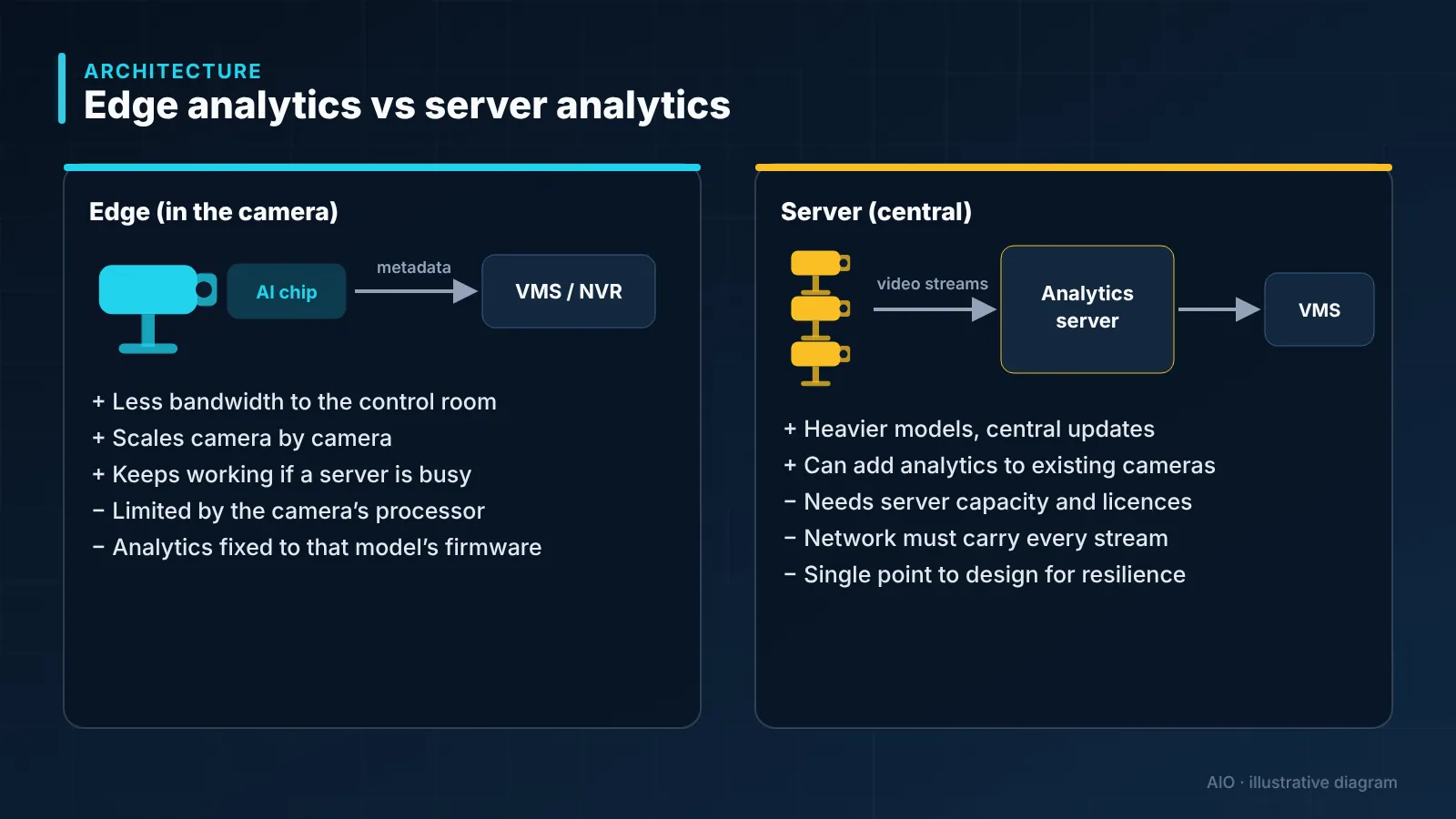
Edge analytics runs inside the camera. It sends events and metadata rather than relying on a central server to analyze every stream, which reduces network load and lets you scale camera by camera. The trade-off is that the analytics are tied to that camera model’s processor and firmware.
Server analytics processes streams centrally. It can run heavier models, update in one place and add analytics to cameras that do not have them, but it needs server capacity, licences and a network that can carry every analyzed stream. Many sites use both: edge rules for perimeters and server analytics for specific investigations or reporting.
If different vendors’ cameras and software must work together, ask whether they support the relevant ONVIF profiles for streaming and analytics metadata (for example Profile S/T for video and Profile M for metadata and events), and confirm the integration in a test rather than on paper.
Key considerations
- Check bandwidth and storage impact for each option.
- Ask how analytics updates are delivered and who approves them.
- Plan what happens to alerts if a server or link fails.
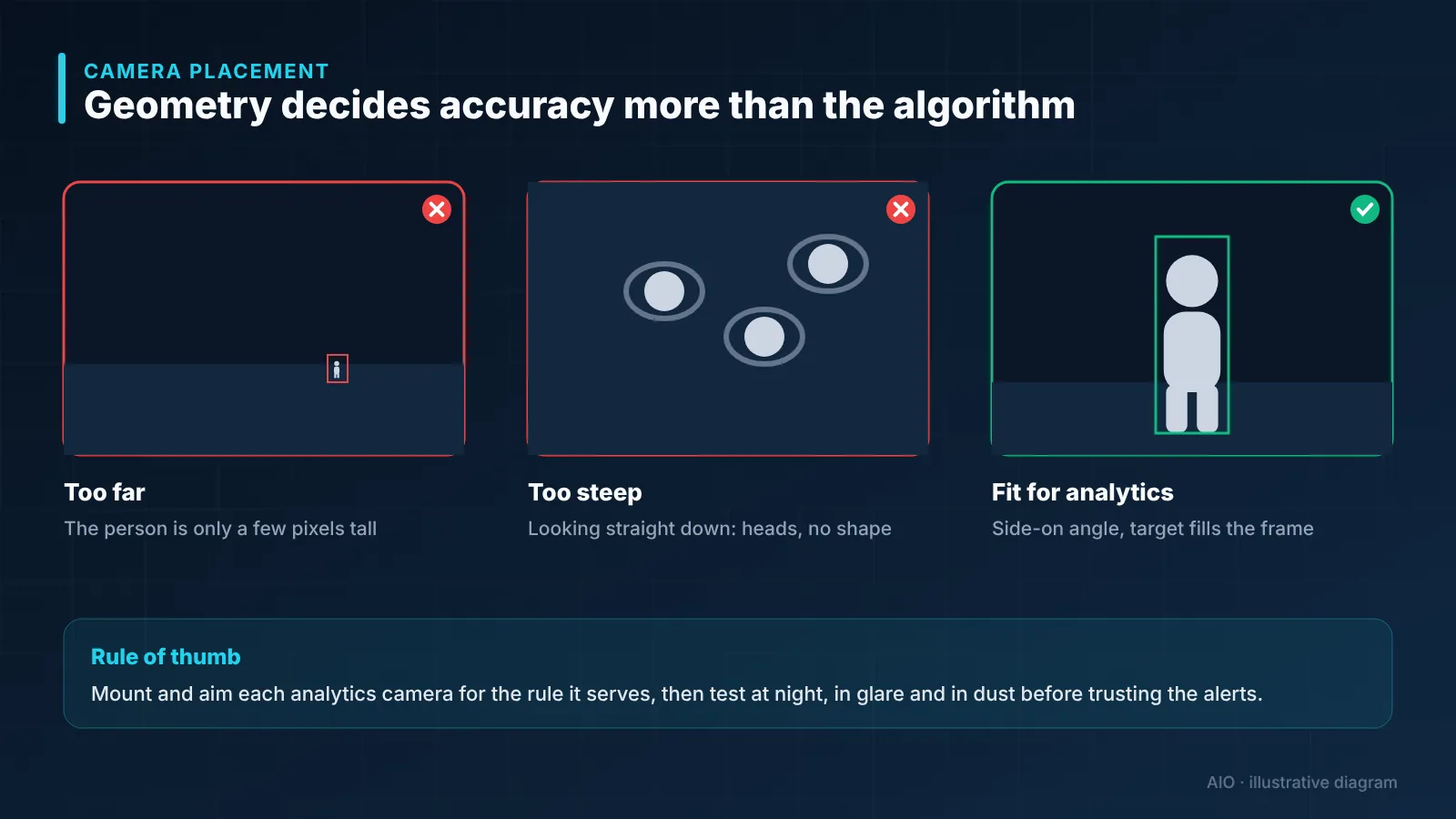
Camera placement decides accuracy more than the algorithm
Analytics needs enough pixels on the target and a viewing angle that shows the object’s shape. A camera mounted very high and aimed almost straight down sees the tops of heads; a camera covering a 100-meter fence line with a wide lens may render a person as a few pixels. In both cases detection becomes unreliable, whatever the software.
A useful reference is the pixel-density guidance in IEC 62676-4, which describes detection, observation, recognition and identification levels in pixels per meter at the target. Use it to size lenses and camera positions for each rule. Then test at night, in headlight glare, in dust and in wind, because those conditions cause most false alarms in Egyptian outdoor sites.
Key considerations
- Dedicate cameras to analytics where the rule matters, instead of reusing a wide overview view.
- Avoid backlit scenes, moving vegetation and reflective surfaces inside detection zones.
- Check infrared illumination range against the actual zone distance.
- Re-check aim after any maintenance, because a small shift can break a line-crossing rule.
Reducing false alarms without switching rules off
The quickest way to lose an operator’s trust is a flood of nuisance alerts. Instead of disabling a noisy rule, find its cause: a flag moving in the wind, headlights sweeping a wall, cats on a fence, or a zone drawn too close to a public road. Most causes have a configuration fix, such as a smaller zone, an object-class filter, a minimum object size, a schedule or a different camera angle.
Agree with the operations team how alerts are prioritized. A line crossing at a perimeter at 02:00 deserves a different response from loitering near a reception desk at noon. The VMS should show priority clearly, and the procedure should state who looks, who acts and how the outcome is recorded.
Key considerations
- Log each alert as true, false or missed during the first weeks.
- Tune one variable at a time and note the change.
- Review rules after seasonal changes in light and weather.
Privacy, data protection and governance
Video and event data can identify people. Egypt’s Personal Data Protection Law (Law No. 151 of 2020) and its implementing rules may apply to how footage and analytics results are collected, stored, accessed and shared. Requirements depend on your organization and use case, so review them with qualified legal advisers rather than relying on a product feature for compliance.
Practical governance helps whatever the legal position: define the purpose of each rule, limit who can view and export footage, set retention periods, keep an audit trail of exports and place clear signage where appropriate. Features that identify specific individuals, such as face recognition, deserve particular care and a clear legal basis before deployment.
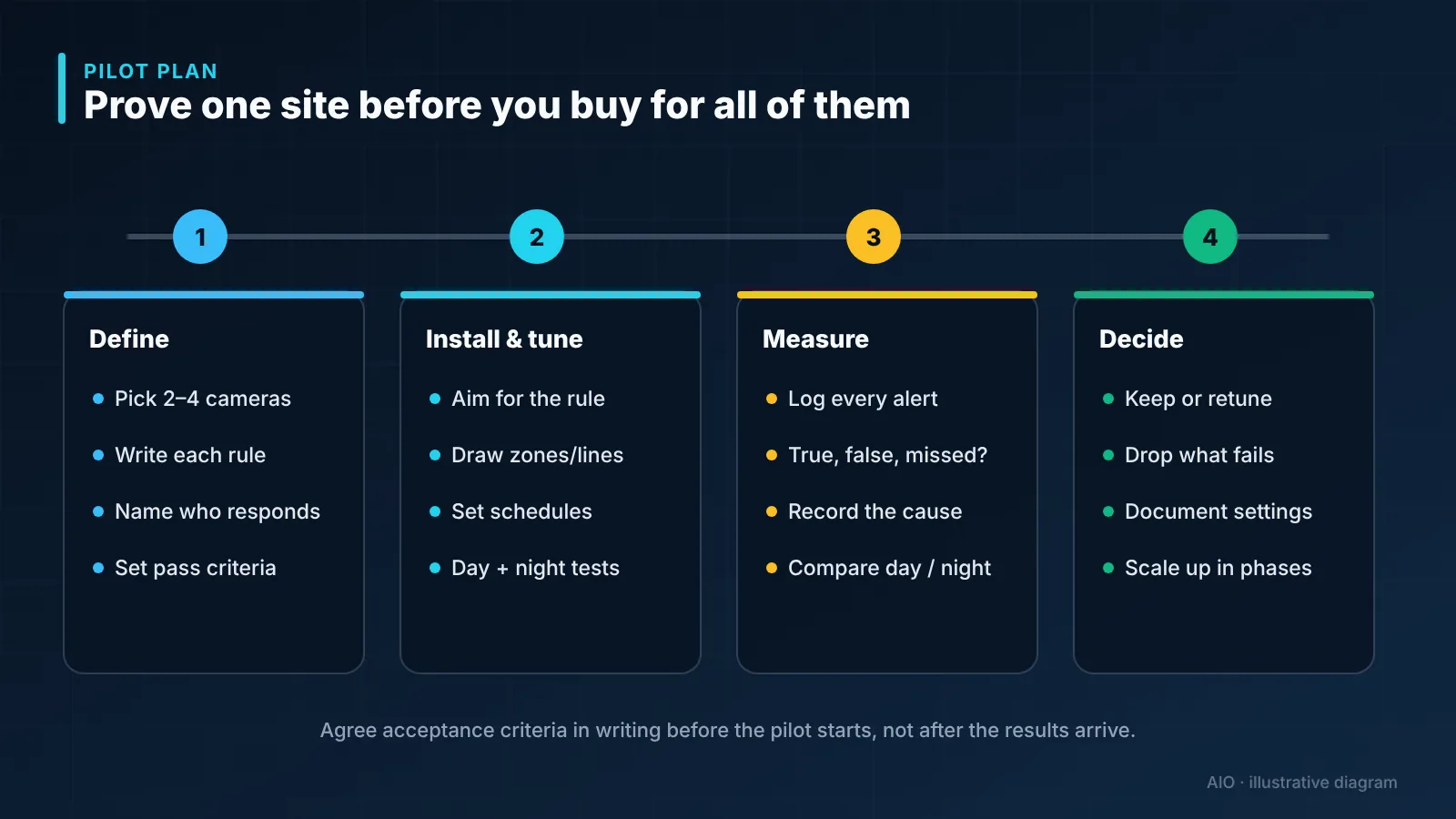
Run a pilot before you scale
A short, well-defined pilot on two to four cameras tells you more than any demonstration video. Write the rules and acceptance criteria before installation, run the cameras through day, night and weather changes, and log every event. At the end, decide rule by rule whether to keep, retune or drop it, and only then roll the configuration out to more cameras and sites.
According to AIO’s Civil division pages, the OpticVision range covers 2MP to 8MP PTZ, bullet and dome cameras with AI-powered analytics, alongside network video recorders and the OpticVision VMS. Request the datasheet for each candidate model to confirm which analytics functions it supports, then use the pilot to test them on your own scenes.
Key considerations
- Pilot scope: cameras, rules, schedules and responders.
- Acceptance: what counts as a pass for each rule.
- Evidence: event log, clips and tuning notes.
- Decision: keep, retune or drop each rule, then scale in phases.
Relevant AIO products & next steps
OpticVision VMS
Review video management options for events, bookmarks and multi-camera viewing.
PTZ Cameras
Explore PTZ models that operators or analytics events can direct to a scene.
Network Video Recorders
Check recording capacity, channels and storage for analytics-enabled systems.
Contact AIO Civil
Request datasheets and discuss rules, sites and a pilot plan.
Further reading
CCTV Cameras & Video Surveillance Systems in Egypt
The broader guide to cameras, recording, VMS and system architecture.
PTZ vs Fixed Security Cameras
When a PTZ adds value and how it works alongside fixed cameras.
ANPR Cameras for Parking and Compound Access Control
Plate recognition, a specialized form of video analytics for vehicle entry.
Factory & Warehouse CCTV Planning (Arabic)
Coverage planning for industrial gates, stores and loading areas.
Common questions
Can AI analytics be added to existing CCTV cameras?
Often, yes, through server-based analytics that processes the existing streams, provided the image quality, angle and network capacity are adequate. Cameras with built-in (edge) analytics are another route when cameras are due for replacement.
Will video analytics eliminate false alarms?
No system is free of false alarms or missed events. Careful camera placement, object-class filters, schedules and a tuning process reduce them substantially, and operator verification remains essential.
Is AI CCTV safety monitoring enough to meet safety obligations?
It can support a safety programme by flagging people in hazardous areas, but it does not replace physical guarding, training, procedures or a formal safety management system.
What should I ask a supplier before buying analytics?
Ask which rules the exact model supports, the conditions they were tested in, how events integrate with your VMS, how updates are delivered, licence costs, and whether you can run a pilot on your own site.
Need to discuss your requirements?
Contact AIO for current model information, datasheets and application-specific technical consultation.