PTZ vs Fixed Security Cameras: When Is a PTZ Worth It on Large Sites?
A PTZ sees detail only where it is pointed. Learn when fixed cameras are the better choice, when a PTZ adds real value, and how to design a hybrid system for yards, perimeters, car parks and campuses.

AIOEGY Editorial Team
Editorial Team
What this guide covers
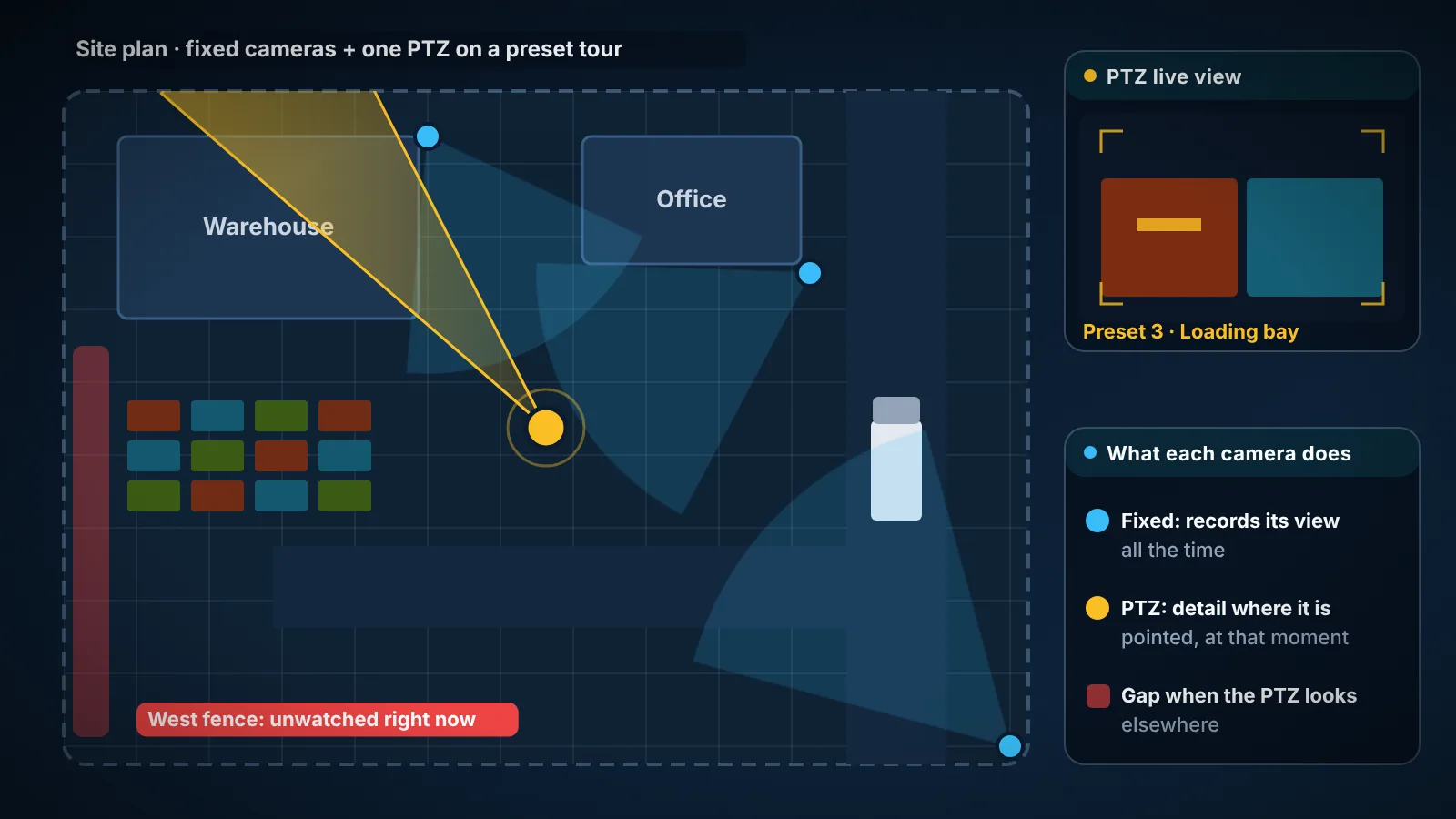
Choose fixed cameras for anything that must be recorded all the time, and add a PTZ (pan-tilt-zoom) camera when someone, or an analytics event, needs to look closer. A fixed camera records its whole field of view continuously; a PTZ sees high detail only in the direction it is pointed at that moment. Most large sites in Egypt get the best result from a hybrid: fixed cameras for evidence, PTZ cameras for detail.
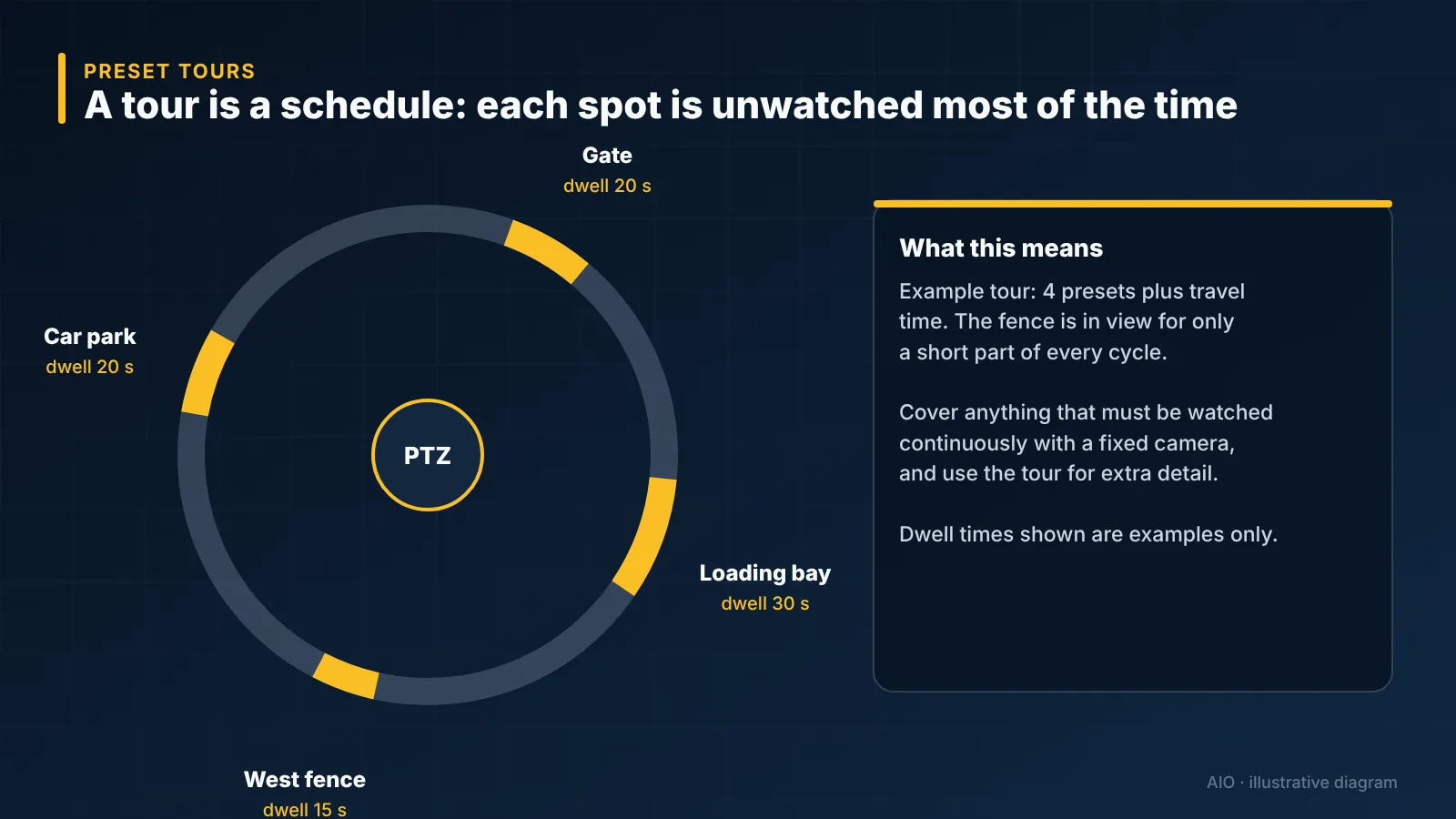
PTZ cameras are excellent on wide yards, long perimeters, car parks, ports and campuses where an operator needs to follow an incident or read details at distance. They are a poor substitute for fixed coverage when nobody is watching live, because a PTZ on a preset tour leaves each spot unwatched for most of every cycle.
This guide compares the two approaches, explains optical zoom and preset tours, covers operator workload and maintenance, and gives a decision matrix. For PTZ planning specifically in factories and large yards, see AIO’s Arabic PTZ guide.
Key takeaways
- Fixed cameras are the evidence base: they record their view all the time.
- A PTZ adds detail where it is pointed, at that moment only.
- Preset tours create gaps; cover must-watch areas with fixed cameras.
- Optical zoom adds detail; digital zoom only enlarges recorded pixels.
- PTZ value depends on live operators or analytics events that direct it.
The core trade-off: coverage vs detail
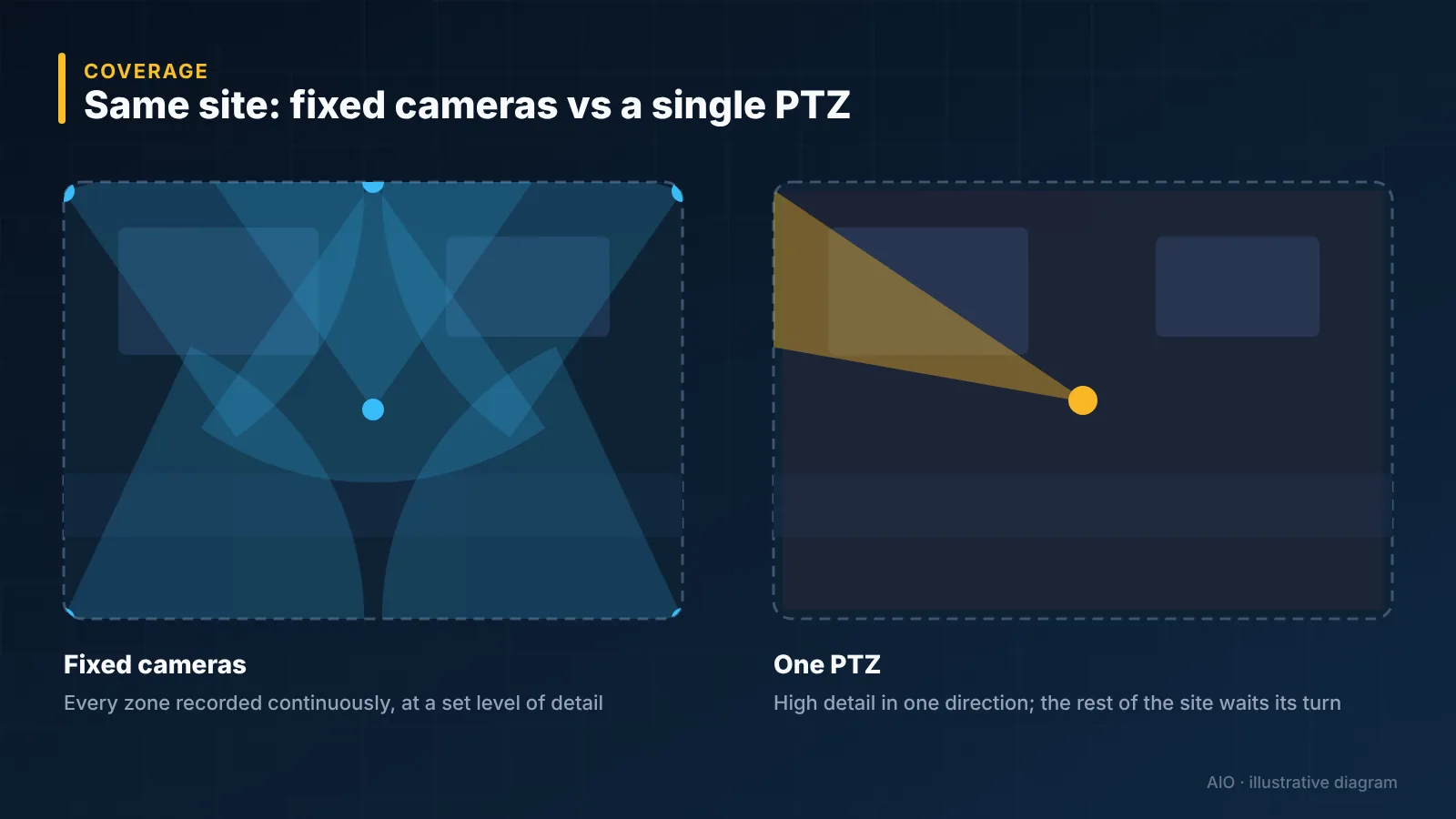
Fixed cameras, whether bullet, dome or fisheye, are aimed once and record the same scene continuously. Their level of detail is set by resolution, lens and distance. A PTZ camera combines a motorized mount with an optical zoom lens, so an operator can swing it toward an event and zoom in for far more detail than a wide fixed view provides.
The catch is that while a PTZ looks one way, it does not look anywhere else. If an incident happens behind it, nothing records that area unless a fixed camera covers it. That is why replacing several fixed cameras with one PTZ almost always reduces real coverage, even if the PTZ is more capable.
Key considerations
- Count which areas must be recorded continuously; those need fixed coverage.
- Identify where extra detail adds value: gates, plates, faces at distance, yard activity.
- Decide who will control the PTZ and when.
When fixed cameras are the better choice
Fixed cameras suit entrances, corridors, cash points, stores, fence sections, loading doors and any area where you need a continuous record. They are simpler, cheaper per view, have no moving parts and are easier to keep accurately aimed for analytics such as line crossing.
Bullet cameras are a natural fit for perimeters and long views; dome cameras suit indoor areas and entrances where a discreet, vandal-resistant housing helps; fisheye cameras give a 360-degree overview of rooms and open-plan areas.
When a PTZ is worth it
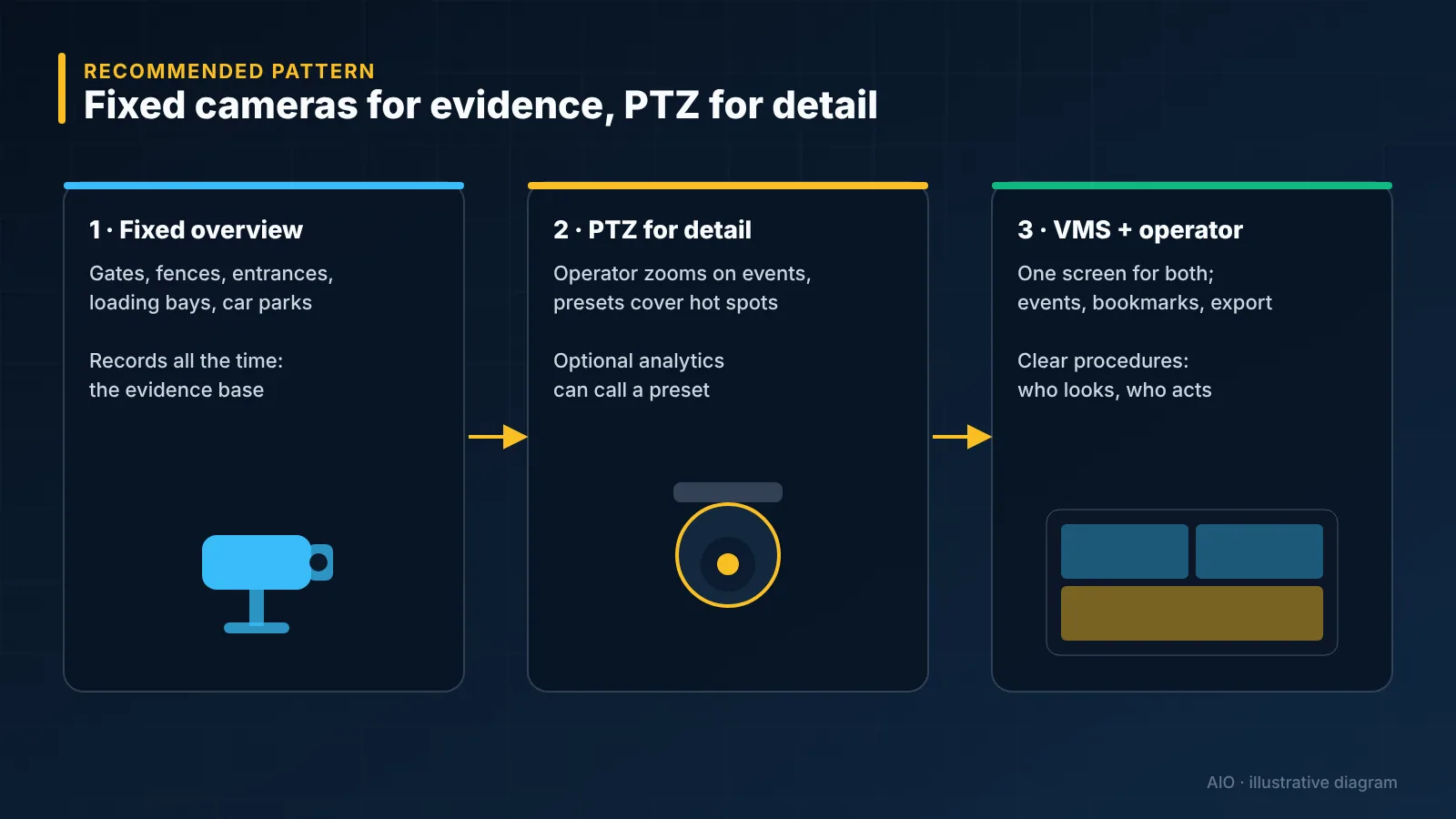
A PTZ earns its place when there is a control room or security team that watches live, when the site is large enough that fixed cameras cannot provide detail everywhere, or when analytics on fixed cameras can call a PTZ preset automatically. Typical examples are logistics yards, container areas, ports, large car parks, campus grounds, tourist sites and city junctions.
The strongest pattern is the hybrid: fixed cameras provide overview and continuous evidence; a PTZ is positioned where it can see most hot spots; and the VMS lets operators jump from a fixed-camera event to the right PTZ preset in one click.
Key considerations
- Mount the PTZ where it has clear lines of sight to the main hot spots.
- Link fixed-camera events to PTZ presets where your VMS supports it.
- Keep at least one fixed overview covering each PTZ’s main area.
Optical zoom, lenses and pixel density
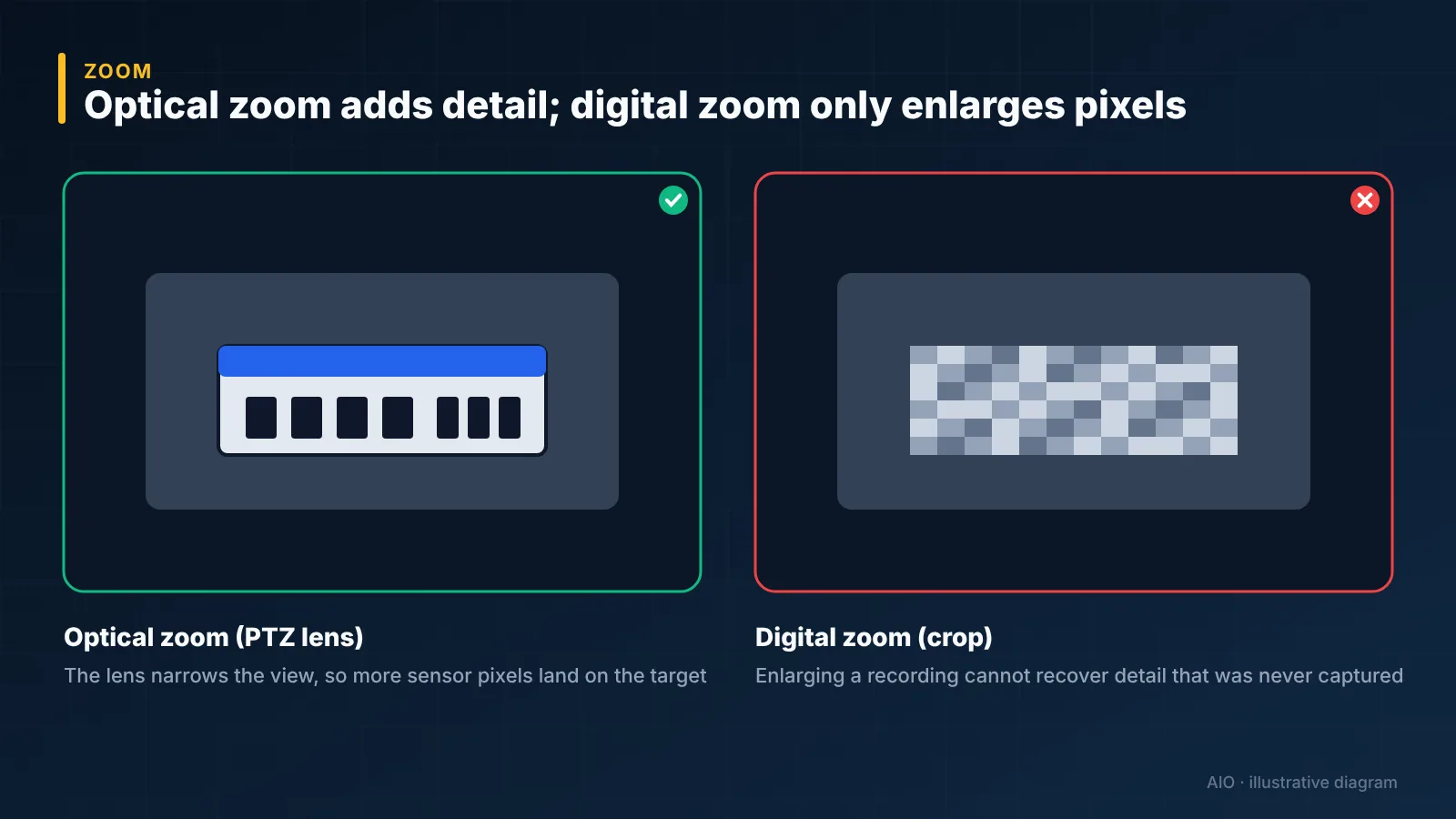
Optical zoom narrows the field of view with the lens, so more sensor pixels fall on the target and more detail is captured. Digital zoom only enlarges pixels that were already recorded; it cannot recover detail that was never captured. When comparing PTZ cameras, look at the optical zoom range, the sensor and the low-light performance at the long end of the zoom, not only the zoom ratio.
The pixel-density levels described in IEC 62676-4 (detection, observation, recognition and identification, measured in pixels per meter at the target) are a practical way to decide what each camera must achieve at each distance. At long zoom, stability matters: wind on a slender pole can make a high-zoom image unusable, so specify the pole and mount for the zoom you intend to use.
Preset tours, auto-tracking and operator workload
A preset tour moves the PTZ through saved positions on a schedule. It is useful for periodic checks but creates gaps: with four presets and travel time, each spot is in view for only part of every cycle. Tours should complement fixed coverage, never replace it.
Auto-tracking can follow a moving object automatically, but it can also be pulled away by the wrong object in busy scenes. Test it in your own conditions and agree when operators should take manual control. Clear procedures (who watches, who acts, how incidents are recorded) matter as much as the hardware.
Key considerations
- Keep tours short and focused on high-value spots.
- Return the PTZ to a useful home position after manual use.
- Review tour coverage when the site layout changes.
Side-by-side comparison
Use the comparison to explain the design choice to stakeholders and to check that each camera has a clear job.
| Factor | Fixed cameras | PTZ cameras |
|---|---|---|
| Coverage | Continuous over a set view | Only where pointed at the moment |
| Detail at distance | Set by lens and resolution | High when zoomed in |
| Best use | Evidence, analytics, entrances, perimeters | Live investigation, tracking, distant detail |
| Operator need | Low | High, or analytics-driven presets |
| Moving parts | None | Pan/tilt motors and zoom mechanism |
| Mounting demands | Standard | Stable pole or wall for high zoom |
| Cost per view | Lower | Higher |
Decision matrix and the OpticVision route
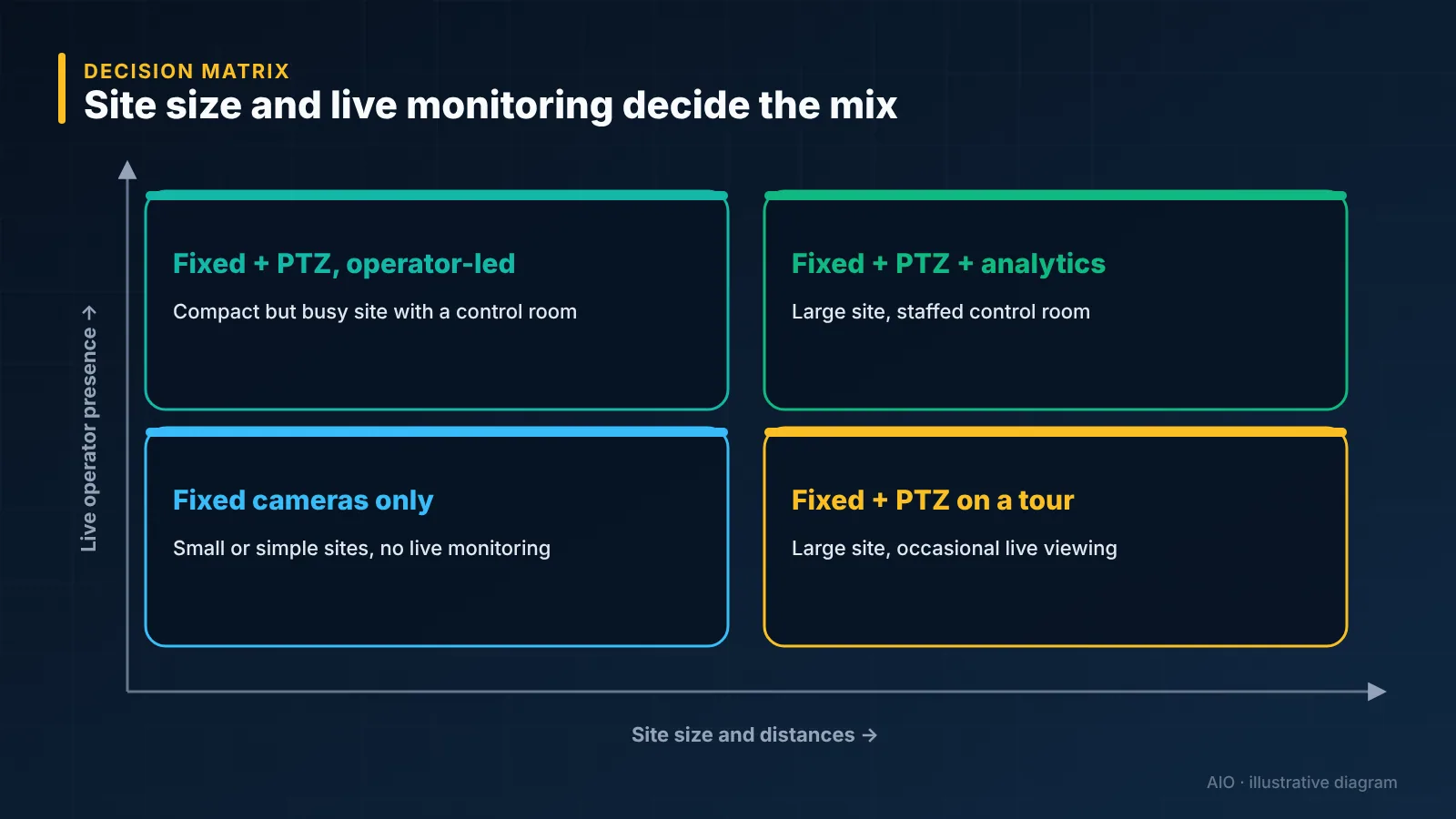
Two questions decide most designs: how large is the site and how far are the distances, and is there a live operator? Small or simple sites without live monitoring usually need fixed cameras only. Large sites with occasional viewing benefit from fixed cameras plus a PTZ on a short tour. Busy sites with a control room get the most from operator-led PTZs, and large staffed sites can add analytics that call PTZ presets automatically.
According to AIO’s Civil division pages, OpticVision offers 2MP to 8MP PTZ, bullet and dome cameras with AI-powered analytics, together with fisheye cameras, network switches, recorders and the OpticVision VMS. Share a site plan with the civil team to discuss a mix, and request model datasheets to confirm zoom range, low-light performance and integration.
Relevant AIO products & next steps
Further reading
PTZ Cameras for Factories and Large Yards (Arabic)
An Arabic guide to choosing PTZ cameras for industrial sites.
Bullet vs Dome Cameras (Arabic)
Choosing the right fixed camera form factor.
AI Video Analytics for CCTV in Egypt
How analytics events can direct PTZ cameras.
CCTV Cameras & Video Surveillance Systems in Egypt
The broader guide to surveillance system architecture.
Common questions
Can one PTZ camera replace several fixed cameras?
Usually not. A PTZ records only where it is pointed, so areas outside its current view go unrecorded. Use fixed cameras for continuous coverage and a PTZ for extra detail.
Do PTZ cameras need an operator?
They deliver the most value with a live operator or with analytics that automatically call presets. Without either, a PTZ is typically limited to a preset tour, which leaves gaps.
Is optical zoom better than digital zoom?
Yes, for detail. Optical zoom captures more detail on the target; digital zoom only enlarges existing pixels and cannot recover detail that was not recorded.
What maintenance does a PTZ camera need?
Periodic checks of pan, tilt and zoom movement, preset accuracy, housing seals, wipers or heaters where fitted, and the stability of the pole or mount. Follow the manufacturer’s maintenance guidance for the model.
Need to discuss your requirements?
Contact AIO for current model information, datasheets and application-specific technical consultation.